
Improving your interior is not just about choosing a wall color or replacing a sofa. Creating a home that reflects you involves understanding how materials, light, and layout interact in each room. The challenge is as technical as it is aesthetic: a choice of flooring alters acoustics, a poorly positioned light fixture flattens volumes, and removing a partition can transform daily circulation.
Energy renovation and interior design: two projects to consider together
Most decor guides treat style and thermal comfort as two separate subjects. In reality, the two overlap. The Climate and Resilience Law of August 22, 2021, imposes a strict timeline on landlords: homes rated G on the energy performance certificate (DPE) are prohibited from being rented out starting in 2025, with F ratings following in 2028 and E in 2034.
For a homeowner planning to redo their living room or kitchen, this constraint changes the order of priorities. Insulating an interior wall reduces the usable space by a few centimeters, which forces a rethink of the furniture. Replacing windows alters the influx of natural light and thus the choice of colors.
Addressing energy renovation before decoration prevents the need to start over. If you plan to insulate the interior, it’s better to do it before applying wallpaper or fixing shelves. The homepage of Significatif gathers resources that help structure this type of project by articulating foundational work and finishing touches.
Color palette and natural light: adapting the choice to the room
The common reflex is to select a shade from a color chart and then apply it everywhere. However, the result depends on the orientation of the room. A warm color in a north-facing room compensates for the lack of direct light, while a pure white in the same configuration creates a cold and flat atmosphere.
Artificial light plays an equally crucial role. A single ceiling light flattens volumes and creates shadowy areas under furniture. Multiplying sources (wall sconces, accent lamps, recessed LED strips) allows for modulation of the ambiance depending on the time of day.
Three criteria for choosing a wall color
- The cardinal orientation of the room: a south-facing exposure tolerates cool shades (blue-gray, sage green), while a north-facing exposure calls for warmer tones (ochre, terracotta, deep beige).
- The ceiling height: dark colors visually bring the ceiling closer. In a low space, reserve them for a single wall to create depth without overwhelming the volume.
- The existing flooring: a light oak floor does not pair well with a straw-yellow wall, which produces a dull monochrome effect. Look for moderate contrast between floor and wall.
Always test a sample directly on the wall in question, at two different times of the day. Color charts seen in stores under neon lights never reflect the actual rendering.
Furniture arrangement and circulation in rooms
A cluttered living room gives an impression of disorder, even with quality furniture. Free circulation between furniture is as crucial for comfort as their aesthetics. Allow for a passage at least the width of your shoulders between two pieces of furniture to keep the room fluid.
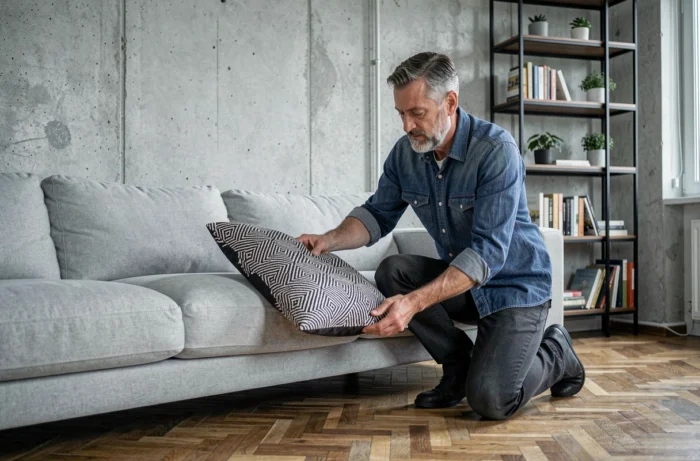
The sofa is often the first piece of furniture placed in a living room, and everything else is organized around it. This reflex works in large rooms, much less so in a small space. In a small living room, start from the focal point (fireplace, bay window, bookshelf) and arrange the seating based on this visual reference.
Multifunctional furniture for small spaces
Dual-purpose furniture is not just for studios. A coffee table with built-in storage, an entry bench that serves as a trunk, a shelf that acts as a divider between two areas: each piece of furniture can serve two functions if the choice is thoughtfully made in advance.
Avoid the trap of choosing a piece that is too small “to save space.” An undersized dining table forces you to eat closely and eventually gets replaced. It’s better to have one well-sized piece than three small ones that interfere with each other.
Textiles and materials: adding character without overloading
Textiles (curtains, cushions, rugs, throws) are the quickest lever to change the atmosphere of a room without renovation. Their role goes beyond decoration: a thick rug improves the sound insulation of a hard floor, and lined curtains reduce thermal losses through windows.
- Favor natural materials (linen, cotton, wool) that age better than synthetic fibers and regulate ambient humidity.
- Limit yourself to two or three dominant materials per room. Mixing raw wood, black metal, and linen creates coherence; adding velvet, rattan, and marble in the same space creates a catalog.
- Touch is as important as visual appearance: a shiny polyester cushion may look elegant in a photo but disappoint in use. Test textures in-store.
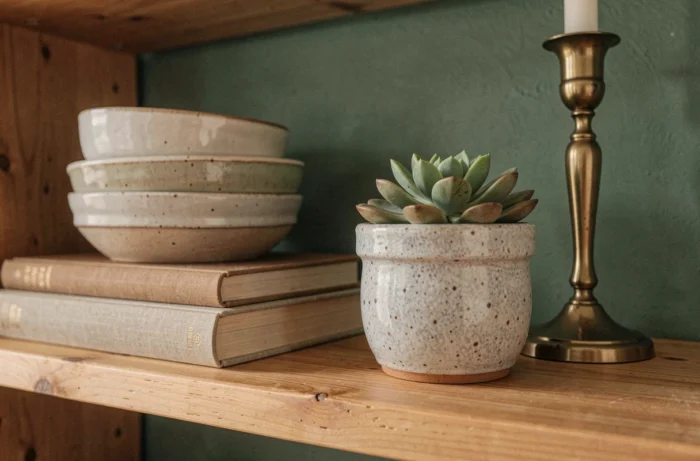
Personal items (books, travel souvenirs, handmade creations) bring a uniqueness that standardized decor cannot replicate. Arrange them in small groups of three to five items on a shelf or console rather than scattering them everywhere. Grouping creates readable points of interest for the eye.
An effective interior is one where every choice, from the flooring to the position of a lamp, responds to a real constraint of the room. Decor trends come and go, but a well-proportioned, properly lit, and insulated room remains pleasant for years.