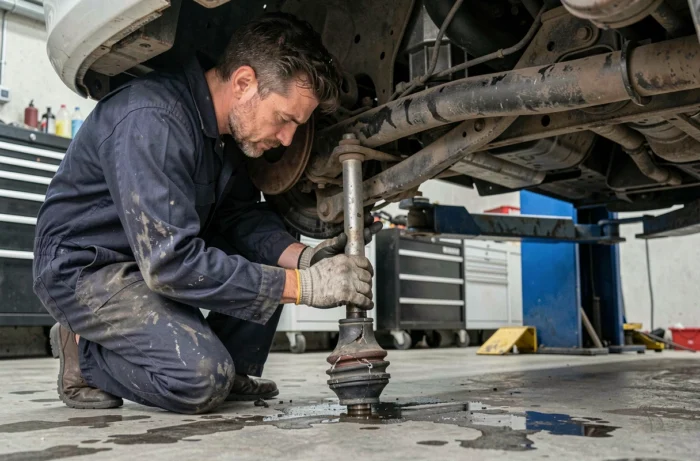
A cracked or missing CV boot will result in a retest at the vehicle inspection. Replacing this part is one of the least expensive repairs on a driveshaft, but the final bill depends largely on the condition of the underlying CV joint and the installation method used.
Split boot or conventional boot: impact on labor costs
Choosing between a conventional boot and a split boot (also known as a “no-removal” boot) can dramatically change the time required for the repair. A conventional boot requires the complete removal of the driveshaft, increasing the number of labor hours charged. The mechanic must drain the old grease, clean the CV joint, apply fresh grease, and reassemble everything.
A split or stretch boot takes less time to install because it fits around the shaft without removing the driveshaft. Compatibility and sealing quality vary by vehicle. This type of kit is not suitable for every model, and an imprecise installation can lead to rapid wear.
To assess the cost of replacing a transmission dust boot, you therefore need to know which installation method the garage is proposing, since the part alone accounts for only a fraction of the total estimate.
CV joint diagnosis: boot only or complete driveshaft
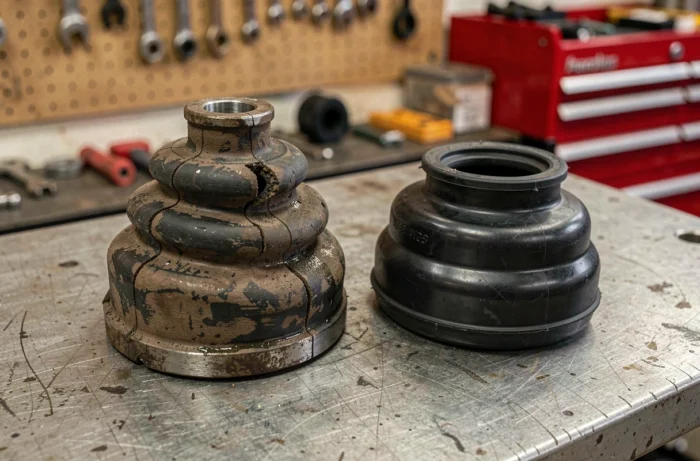
A preliminary diagnosis determines the true scope of the repair. If a boot has only recently torn and there is no visible contamination of the joint, replacing the boot and grease alone may be sufficient. However, if dust, water, or mud has entered the CV joint, the complete driveshaft must be replaced.
We recommend asking the garage to specify in writing the proposed work and the reasons for its diagnosis. An estimate stating “CV boot replacement” does not cover the same work as one stating “left-side transmission replacement.”
Signs that the CV joint is already damaged
- Clicking or cracking noises when turning sharply at low speeds, indicating excessive play in the joint
- Blackish grease splattered around the boot, indicating advanced contamination by abrasive particles
- Vibrations while driving, particularly during acceleration, indicating an imbalance in the driveshaft
If these symptoms are present, replacing the boot alone will not solve the problem. An unreplaced damaged driveshaft will eventually break, potentially leaving the vehicle stranded.
Factors that affect the cost of replacing a CV boot
Two estimates for the same repair can differ significantly. Before comparing them, make sure they cover the same work.
What the estimate should include
- The exact part reference (rubber or thermoplastic boot, OEM supplier brand or aftermarket)
- The side affected (front left, front right, or both) and the installation method (with or without driveshaft removal)
- Included consumables: specialist grease, clamps, and a transmission nut if required
- The labor time charged, listed in hours or as a flat rate
The vehicle model has a major impact on the bill. On some vehicles, such as Peugeot models with a compact layout, access to the driveshaft on the gearbox side is limited, which increases the time required. All-wheel-drive vehicles have more potential repair points.

The quality of the replacement boot also matters. An OEM-supplier neoprene rubber boot withstands temperature fluctuations and chemical exposure (road salt, oil) better than a low-cost generic boot. Any savings on the part often come at the cost of having to replace it sooner.
Vehicle inspection and dust boots: what triggers a retest
A missing or cracked transmission dust boot is a defect that requires a retest. The inspector visually checks the condition of the CV boots on both sides (front left and front right on a front-wheel-drive vehicle). Even a partial crack is enough to result in a failed inspection.
The retest must be completed within the legally prescribed period after the initial inspection. Waiting increases the risk of damaging the CV joint, turning a minor repair into a complete driveshaft replacement.
Preventive replacement during a service or routine maintenance is the most cost-effective approach. A boot with hairline cracks visible to the naked eye, but not yet leaking grease, is nearing the end of its life. Replacing it at this stage prevents joint contamination and the resulting repair bill.
Service life and materials
Natural rubber boots age faster than thermoplastic elastomer boots, especially in regions where vehicles are exposed to road salt and moisture. Boot wear depends not only on mileage but also on weather conditions and the state of the roads driven on.
Replacing a dust boot in time protects a CV joint that costs several times as much. The part itself is affordable, but the diagnosis and installation method determine the final bill. Always ask for the exact scope of work before approving an estimate.