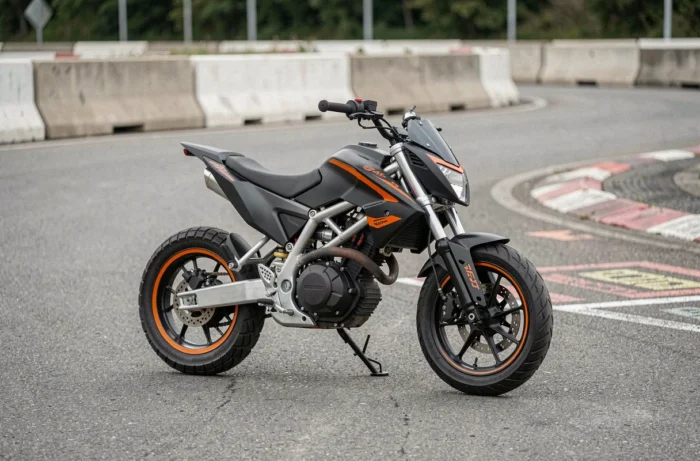
On an industrial zone parking lot transformed into a track on Sunday mornings, more and more pit bikes equipped with 12-inch slick tires, wide handlebars, and rear-set footpegs can be seen. The supermoto format applied to the pit bike radically changes the machine’s behavior: flat corners on asphalt, late braking, tight trajectories.
Choosing the right supermoto pit bike model in 2024 requires understanding what truly distinguishes a supermoto preparation from a simple wheel kit, and why some machines endure the sessions while others fail after just a few hours.
Chassis and Geometry: What Makes a True Supermoto Pit Bike
A pit bike sold as “supermoto” is not always designed for this use. On some entry-level models, the manufacturer simply mounts 12-inch wheels with road tires on a frame intended for dirt. The result: too high ground clearance, an unsuitable wheelbase, and suspensions calibrated to absorb bumps, not to maintain contact in corners on asphalt.
What we seek in a well-designed supermoto pit bike is a frame with a more open steering head, stiffer forks (ideally inverted), and a reinforced swingarm. YCF, Malcor, and certain models from the IMR range offer versions specifically developed for supermoto, with revised geometry and components sized for asphalt.
You can check the supermoto pit bike comparison on Sportivoz to visualize the geometry differences between the main models on the market.
Suspensions: Firmness and Reduced Travel
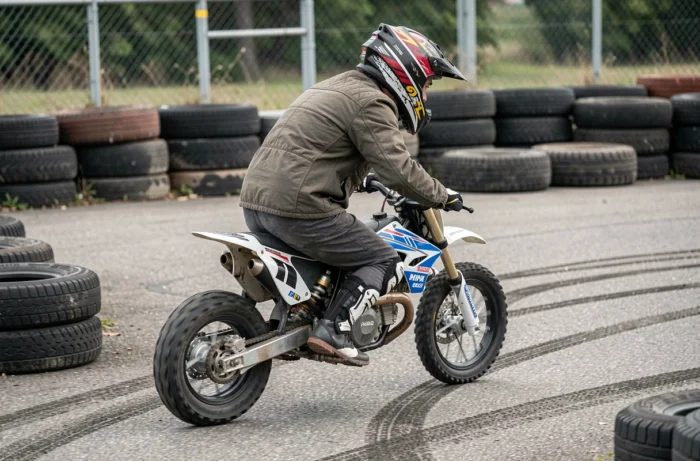
In supermoto, we ride on flat surfaces or nearly so. Long travel generates bobbing during braking and makes the bike feel vague when entering a corner. The most suitable models feature inverted forks with limited travel and a rear shock adjustable in preload and rebound. If the stock machine has overly soft suspensions, recalibration or replacement is necessary before riding.
Supermoto Pit Bike Engine: Displacement and Engine Character
The majority of supermoto pit bikes revolve around two families of engines: blocks derived from Lifan/Zongshen (found on many Chinese models and some Malcor) and Daytona engines, known for being more reliable at high RPMs. YCF uses its own blocks on certain ranges, focusing on mid-range usage.
For supermoto on parking lots or small tracks, an engine between 150 and 190 cc offers the best compromise between manageable weight and strong acceleration. The 125 cc blocks are suitable for lightweight or beginner riders but lack punch when exiting corners for an adult. The 190 cc, being more torquey, are more forgiving of gear errors.
Engine Reliability After Several Sessions
A point rarely addressed in product sheets: the engine’s endurance during repeated sessions. In supermoto, the engine runs for long periods at high RPM, with few rest phases. Entry-level blocks overheat, oil degrades quickly, and head gaskets fail if oil changes are not done regularly.
It is recommended to check the oil change frequency suggested by the manufacturer and to halve it for track use. Models equipped with an oil cooler, even a small one, hold up significantly better over time.
Braking and Wheels: Key Areas Not to Overlook
Braking makes all the difference in supermoto. On asphalt, an undersized front disc or poor-quality pads turn every end of the straight into a moment of stress. Serious models come with a front disc of at least 220 mm with a two-piston caliper.
- 12-inch aluminum rims are the supermoto standard for pit bikes. Ensure they are well-laced and balanced, especially on models delivered in a crate from the factory.
- 12-inch road tires remain a niche market: the most commonly used references come from PMT or Ohvale. Budget specifically for this, as the stock tires are often mixed types that perform poorly on dry asphalt.
- Brake pads wear out quickly in supermoto. Having a spare set in your bag is a habit to adopt from the first session.
DICEM Declaration and Insurance: Two Distinct Processes
Before discussing the track, a regulatory reminder often misunderstood. Non-homologated pit bikes must be subject to a DICEM declaration (Declaration of Identification of Motorcycles). This declaration does not equate to homologation or authorization to circulate on public roads. It assigns an identification number, but the machine remains prohibited on public roads.
Insurance is a separate process. A federal license covers civil liability in competition or supervised training, but it does not cover damage to the machine itself. For free sessions on private land, it is essential to check that specific insurance covers the actual usage framework.
Practical Consequences for Model Choice
If you only ride on private tracks or closed parking lots, the lack of road homologation is not a hindrance. However, some models sold as “ready to ride” arrive without a stand, mirrors, or lighting, confirming their strictly track-oriented purpose. It’s better to know this before purchasing to avoid wasting time looking for unnecessary equipment.
Criteria for Choosing a Supermoto Pit Bike According to Rider Profile
The right model depends less on the brand than on the compatibility between the machine and the actual use. An average-sized adult starting in supermoto does not need a 190 cc racing bike with competition suspensions. A well-tuned 150 cc, with a proper front brake and suitable tires, is more than enough to progress throughout an entire season.
- For children and teenagers, models in 110 or 125 cc with electric start and semi-automatic clutch facilitate learning without frustration.
- For an intermediate adult, a 150 to 190 cc with inverted forks and hydraulic front/rear disc brakes provides a solid foundation.
- For experienced riders, the quality of the suspensions and braking takes precedence over raw power. A rigid frame and adjustable components allow for fine-tuning performance session after session.
Engine reliability, availability of spare parts, and braking quality weigh more than the raw technical sheet. A supermoto pit bike that breaks down after three sessions costs more than a slightly more expensive model designed to last.