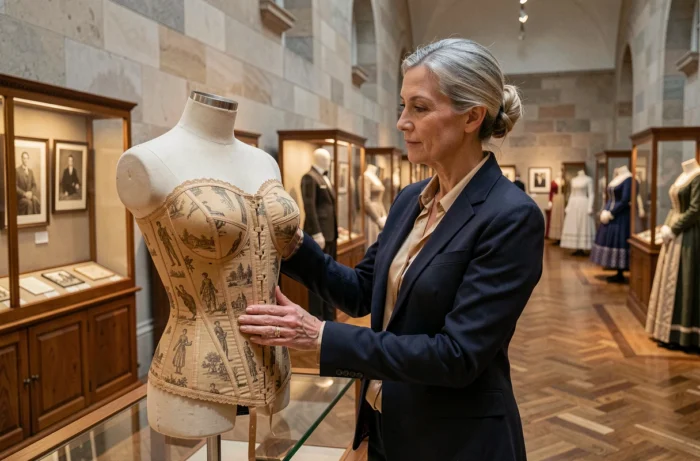
Clothing has accompanied humanity since its first steps. Initially a protection against the cold, it has become a marker of rank, a political tool, and then a field for individual expression. Tracing the evolution of fashion is to follow the transformations of the societies that have embraced it, from ancient drapery to the digital passports mandated by European regulations in 2026.
Clothing as a social infrastructure before fashion
Talking about fashion in antiquity or the Middle Ages is an oversimplification. For centuries, clothing was not a matter of personal taste but of a system of class codification. In ancient Rome, the width of the purple band on the toga indicated the senator’s rank. The fabric itself, whether linen or wool, signaled geographical belonging as much as status.
In the Middle Ages, sumptuary laws regulated what each category of society could wear. Silk was reserved for the nobility and clergy. Bright colors, furs, and the length of trains were regulated. Clothing did not express a trend: it maintained an order.
This rigid framework did not disappear during the Renaissance, but it began to crack. The rise of trade between Venice, Florence, and Paris circulated Eastern fabrics. The merchant classes began to imitate the court, forcing aristocrats to renew their dress codes to distinguish themselves. It is this mechanism of imitation and differentiation that produces, for the first time, a cycle resembling what we call fashion.
To delve deeper into the evolution of fashion with Mode in Paris, one must trace back to these dynamics of textile circulation that preceded haute couture by several centuries.

Paris, couture, and the birth of a system in the 19th century
The shift occurs in the second half of the 19th century. Charles Frederick Worth opens his fashion house in Paris and introduces a radically new model: the couturier no longer merely executes the orders of a client but proposes his own creations. The dress becomes a signed work.
This change has profound consequences. Clothing enters a logic of seasons, collections, and fashion shows. Paris concentrates the power of prescription. The first fashion magazines disseminate Parisian silhouettes throughout Europe and the United States. Fashion ceases to be a privilege of the court and becomes an industry.
What Worth really changed
The Worth model is not just about aesthetics. It establishes a hierarchy between haute couture and ready-to-wear, between creation and reproduction. This distinction still structures the clothing industry. It explains why Paris remains, in the collective imagination, the fashion capital, even though Milan, London, and New York have since developed their own ecosystems.
Popular fashion and ready-to-wear: the 20th century reshuffles the deck
The 20th century accelerates the democratization of clothing. The two world wars impose material constraints (rationing, fabric shortages) that force innovation and permanently alter silhouettes. Women wear trousers out of necessity in factories, then by choice.
The post-war period sees the emergence of ready-to-wear as an alternative to haute couture. Trends no longer only descend from Parisian houses to the street: the street begins to influence creators. Jeans, originally workwear from America, become a symbol of counterculture and then a universal staple.
- The 1960s see Mary Quant’s miniskirt transform the female silhouette and the codes of dress decency in just a few seasons.
- The 1970s blend ethnic influences, disco, and identity claims, blurring the line between fashion and activism.
- The 1980s establish fashion as a media spectacle, with designers like Thierry Mugler and Jean-Paul Gaultier staging their shows.
This period also marks the massive industrialization of the textile sector. Production is relocated, prices drop, and volumes explode. Clothing becomes a fast-moving consumer good, paving the way for the fast fashion of the following decades.
European regulation 2026: fashion faces traceability
The history of fashion does not stop at the runways. In 2026, the sector faces a regulatory paradigm shift. The European regulation on the eco-design of sustainable products (ESPR) has come into effect, and the destruction of unsold clothing is now regulated for large companies.
The European register of the Digital Product Passport has been operational since July 2026. Each textile product will ultimately need to be accompanied by a digital passport covering:
- The material composition and any concerning substances used during manufacturing.
- The reparability and recyclability of the product, assessed according to harmonized criteria.
- The traceability of the supply chain, from thread to finished garment.
This system changes the way brands design, document, and market their products. Compliance is no longer about the label but about the product data. Brands must structure information flows that have previously been non-existent in the sector.
A turning point whose effects remain to be measured
Field reports diverge on this point. Some brands have anticipated compliance, while others are discovering the extent of the technical requirements. Fine traceability requires digital tools, supplier audits, and a redesign of internal processes. The real cost of this transition has not yet stabilized.
Fashion has traversed centuries by absorbing the constraints of each era, from medieval sumptuary laws to wartime restrictions. The regulatory framework of 2026 represents a new kind of constraint, technical and documentary rather than material. How the industry integrates it will say much about the next phase of its history.