
The online shoe market is undergoing a phase of restructuring. Shopping journeys are fragmenting between social networks, price comparison sites, trying on in-store, and final validation on an e-commerce platform. Traditional categories (sneakers, heels, boots) are blurring with the emergence of hybrid silhouettes. In this context, finding the right trendy pair of shoes this season requires understanding how these new circuits work before pulling out the credit card.
Omnichannel shopping journey: what’s changing to find shoes online
Buying shoes online is no longer just about typing a query into a search engine. According to a study by biggie GROUP on the back-to-school season of 2026, more than 4 out of 10 French people combine online shopping with in-store visits. The typical pattern looks like this: discovering a model on TikTok or Instagram, checking the price via Google Shopping, reading customer reviews, trying on in-store, and then placing the final order on the site that offers the best deal.
This fragmented journey has a direct consequence on how to find good deals. Comparing prices across platforms is no longer enough. It is also necessary to cross-reference feedback on comfort, actual size, and material quality. Consulting reviews on shoes on Globe Modeuse allows for example to compare real-life feedback before confirming a purchase.
French families plan to allocate a higher budget than in 2025 for back-to-school shopping, but they compensate by extending the lifespan of products and turning to resale platforms like Vinted. The comparison reflex is intensifying, and the displayed price is no longer the only decision criterion.
Hybrid silhouettes: sneakerinas, sporty mules, and the end of classic categories
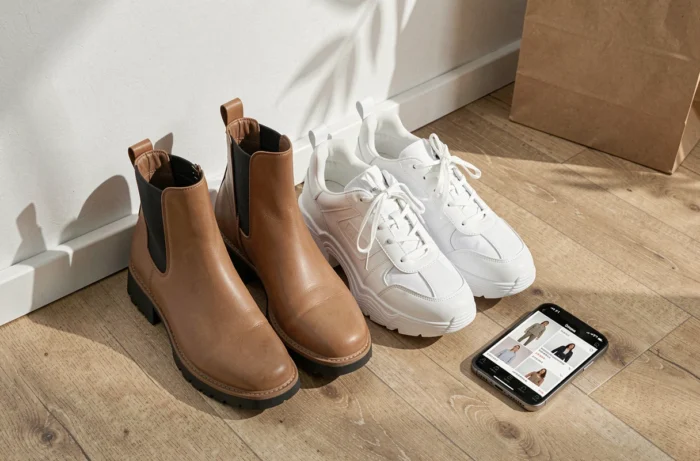
The 2026 market reports on shoes highlight a strong trend: the rapid growth of hybrid silhouettes that blur the lines between sneakers and dress shoes. Sneakerinas (a cross between sneakers and ballet flats), sporty-soled mules, or technical ballet flats are gaining ground in online catalogs.
This evolution complicates the search for buyers. Typing “women’s sneakers” or “leather heels” into a search engine returns results that only cover a fraction of the actual offering. Hybrid models are often classified in vague subcategories or even absent from the navigation filters of major platforms.
Adapting your search to new categories
To stumble upon these models, one must broaden the search vocabulary. Terms like “office fashion shoes,” “dressy sneakers,” or “sporty ballet flats” provide access to selections that traditional filters overlook. Some specialized sites organize their catalogs by usage (office, weekend, evening) rather than by type of shoe, which facilitates navigation.
- Search by occasion (office, outings, urban walking) rather than strict product category to access hybrid models
- Check the composition of the sole and the upper separately, as a “ballet flat” model may incorporate a technical sneaker sole
- Cross-reference comfort reviews with style reviews, as the two are not always correlated on product sheets
Anti-fast fashion law and environmental labeling: what this changes for online shopping
Since September 2026, France has implemented an anti-fast fashion penalty that significantly alters the available online offering. Brands producing very high volumes at low cost face additional costs that are reflected in the displayed prices. For consumers, the price gaps between fast fashion and mid-range brands are narrowing.
At the same time, textile environmental labeling is progressing. Platforms will eventually have to display an environmental score on each product sheet. This system, set to come fully into effect in October 2026, changes the game for online buyers who will be able to compare not only price and style but also the environmental impact of a pair of shoes.
What consumers can check right now
Field feedback varies on the current reliability of these scores. Some brands already display a voluntary index, while others are waiting for definitive regulations. In the meantime, a few checks remain accessible to any online buyer.
- Look for whether the product sheet mentions the country of manufacture and the exact composition of the leather or textile
- Check the return policy: a short return period (less than 14 days) may indicate a desire to limit returns rather than a guarantee of quality
- Prefer platforms that detail production conditions, even partially, over those that only provide a generic label
Reliability of reviews and common pitfalls on shoe sales platforms
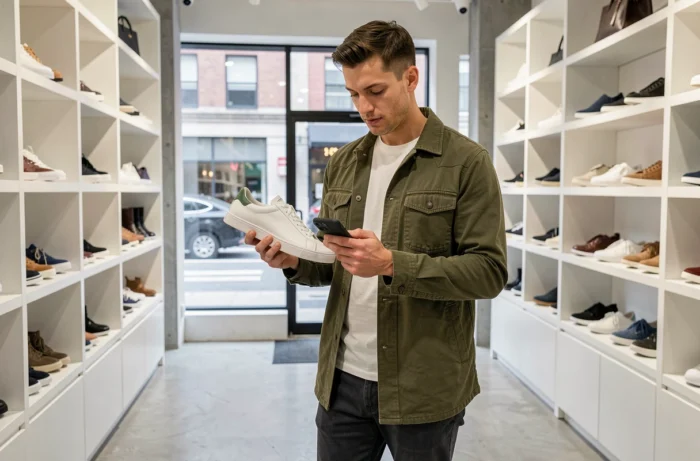
The multiplication of shopping channels comes with a recurring problem: the variable reliability of customer reviews on shoes online. Major marketplaces aggregate reviews from very different sources, and overall ratings often mask disparities in fit, foot width, or durability after a few weeks of use.
A classic pitfall concerns sizing. Brands do not all share the same sizing reference. A size 38 from an Italian brand does not correspond to a size 38 from a British manufacturer. The size guides provided by platforms are rarely updated and poorly reflect variations from one model to another within the same brand.
Verification strategy before purchase
Rather than relying on the average rating, filtering reviews by the same size as yours yields much more useful results. Looking for reviews mentioning “after a month” or “after several weeks” helps assess longevity, a criterion that unboxing photos never cover.
Comparing the same model on at least two different platforms remains the most reliable method to spot inconsistencies in price or description. Some platforms inflate reference prices to display artificial discounts, a mechanism that direct comparison neutralizes.
This season, online shoe shopping is less about model selection and more about the purchasing method. Omnichannel journeys, hybrid silhouettes that are difficult to filter, ongoing environmental regulations, and customer reviews to analyze: the ideal pair is found at the intersection of several checks, not on the first page of results from a single platform.