
A ladybug resting on an interior wall, a window, or a curtain almost always elicits the same reaction: a smile, followed by a question. The answer varies depending on the chosen framework, biological or symbolic, and the two perspectives convey entirely different meanings.
Ladybug in the house: biological reading versus spiritual reading
Before attributing a hidden meaning to this visit, it is essential to distinguish what entomology explains from what spiritual traditions project. The table below compares the two interpretative frameworks for the most common situations.
| Observed situation | Biological explanation | Common spiritual interpretation |
|---|---|---|
| A solitary ladybug enters through the window in spring | Searching for aphids or pollen, exploratory flight post-hibernation | Sign of imminent luck, personal renewal |
| Several ladybugs grouped together in autumn | Collective hibernation behavior (especially Harmonia axyridis) | Enhanced protection of the home, group energy |
| Ladybug resting on a person | Attracted by body heat and light colors | Personal message, wish to be made |
| Unusually colored ladybug (yellow, orange) | Normal interspecific variation | Specific meaning related to the color |
The gap between the two columns is striking. Biology describes survival mechanisms (temperature, food, shelter), while the spiritual reading assigns intention to the insect’s behavior. Understanding the spiritual meaning of the ladybug in the house first requires knowing which framework one is operating within.

Asian ladybug or seven-spotted ladybug: the species changes everything
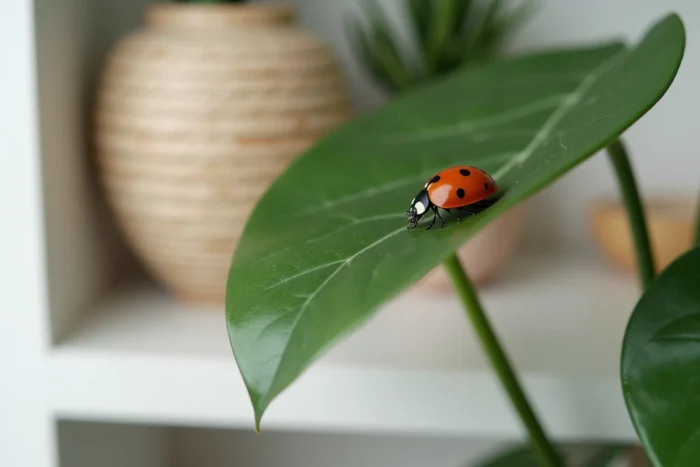
A detail rarely mentioned in texts dedicated to symbolism: the species of ladybug radically alters the context of its presence. The seven-spotted ladybug (Coccinella septempunctata), native to Europe, rarely enters homes in large numbers. Its visit remains occasional, linked to erratic flight or the presence of aphids on indoor plants.
The Asian ladybug (Harmonia axyridis), on the other hand, colonizes buildings by the dozens, even hundreds, as winter approaches. It seeks protected hibernation sites, and light-colored facades facing south particularly attract it. This seasonal survival behavior falls under entomology, not a mystical sign.
Differentiating the two species requires a bit of observation:
- The seven-spotted ladybug has exactly seven black spots on a bright red background, with two characteristic white spots on the pronotum (the visible “head”)
- The Asian ladybug exhibits a wide variability of colors (red, orange, yellow, sometimes black) and a highly variable number of spots, often accompanied by a “M” or “W” shaped pattern on the pronotum
- A massive grouping on window frames or in attics almost systematically indicates Harmonia axyridis
An isolated visit from a native ladybug carries a completely different symbolic weight than a seasonal invasion of an introduced species. This distinction between species, season, and behavior serves as a crucial interpretative filter before any interpretation.
Spiritual messages of the ladybug: what traditions really say
The ladybug is nicknamed “God’s little beast” in the French Christian tradition. This association dates back to medieval tales where the insect supposedly spared an innocent condemned person. The link between the ladybug and divine protection is rooted in this type of popular storytelling, not in a sacred text.
In the realm of European folk beliefs, a ladybug landing on a person invites a wish to be made. The direction of its flight would indicate where luck will come from. These codes have circulated abundantly online in recent years, often enriched with correspondences between the number of spots and a specific meaning (love, money, travel).
The number of spots and color: written traditions or recent invention
Interpretative frameworks based on the number of spots or color (red for love, yellow for creativity, orange for vitality) do not rely on any identifiable ancient written tradition. They have primarily developed on social networks and personal development blogs. This does not diminish their value for those who find meaning in them, but they must be situated in their real context: a contemporary construction, not a millennia-old heritage.
This observation changes the way the “message” is received. Rather than a fixed code to decipher, the presence of a ladybug functions more as a projective support: each person reads what resonates with their current situation.
Confirmation bias and salience effect: why the ladybug “speaks”
Psychology offers a third perspective, complementary to the first two. Confirmation bias leads one to retain events that validate a pre-existing belief. If one believes that the ladybug brings luck, they will notice its presence and forget the dozens of times no insect appeared before a positive event.
The salience effect also plays a role: the ladybug attracts attention with its bright colors and recognizable shape. A gnat that entered through the same window does not trigger any spiritual questioning. The brain filters, selects, and assigns meaning to stimuli that stand out from the daily background noise.
This mechanism does not invalidate the lived experience of the person. It places it within a framework where meaning arises from the interaction between the observer and the event, not from the event alone.
Ladybug and spirituality: the decisive data
The structuring fact is this: the majority of ladybugs found in homes in autumn and winter are Asian ladybugs in hibernation. This documented and predictable behavior affects thousands of households each year. The spring or summer visit of a solitary native ladybug remains a much rarer event, and it is precisely this rarity that gives it, in the symbolic realm, a remarkable character.
Attributing a spiritual message to every ladybug sighted amounts to confusing a mass phenomenon with an individual sign. The species, season, and context separate a biologically mundane situation from an encounter sufficiently rare for some to choose to read a meaning into it.