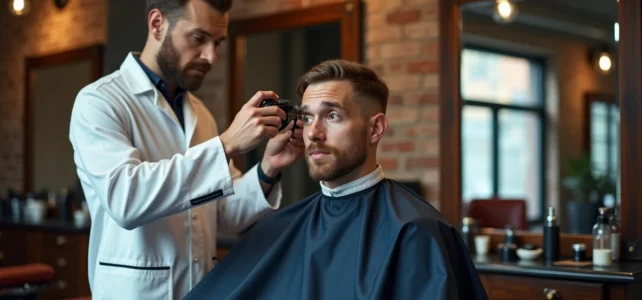
The low fade is not chosen from an inspiration board. It is calibrated based on three parameters that most guides overlook: the density of hair on top, the presence or absence of a beard, and the frequency of visits to the barber. Mastering the low fade haircut techniques for men requires reasoning in terms of hair constraints before considering the visual outcome.
Height of the low fade: beard, density, and maintenance as decision criteria
Placing the fade line one or two centimeters above the ear is not an arbitrary aesthetic choice. The height of the fade primarily depends on the beard. A thick beard that rises high on the cheek requires a low fade positioned just above the tragus, so that the beard-hair transition remains clear without creating an inconsistent density area.
Without a beard, or with a short goatee, the margin for maneuver increases. The fade can start slightly higher without disrupting the profile balance.
The density of hair on top plays a symmetrical role. On fine hair, a very short fade at the bottom accentuates the contrast with the remaining volume, which can betray a lack of substance. The principle of the internal fade relies on soft transitions, where the lower strands are cut shorter than those on top without ever reaching the skin.
To delve deeper into the low fade haircut techniques for men, it is useful to note that the current trend leans towards these natural and less contrasted fades, particularly suited for fine hair.
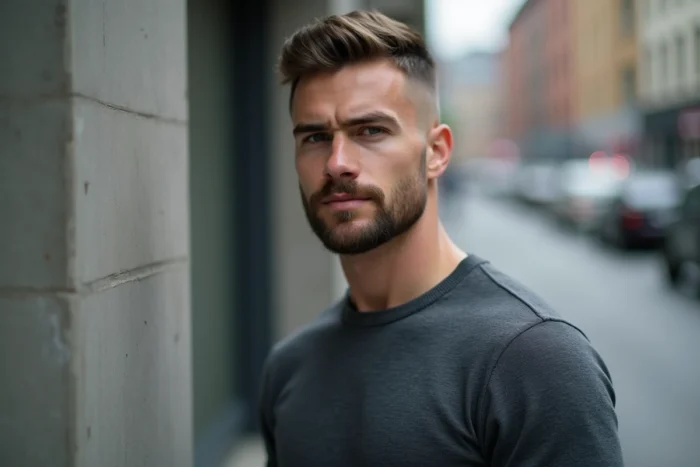
The available maintenance time often influences the debate. A very sharp low fade, with a bald fade on the nape, loses its geometry by the second week of regrowth. A man who only visits the barber once a month would benefit from opting for a more gradual fade, which ages without a visible demarcation line.
Clippers lever technique on afro and textured hair
On afro or very textured hair, simply changing the guard is not enough to produce a clean fade. The lever of the clippers is the main tool for the fade, not the cutting comb. The barber gradually opens and closes the lever to modulate the cutting length by fractions of a millimeter, which creates finer transitions than with interchangeable guards.
The trimmer then comes into play for the outlines. The back line, often neglected, determines the cleanliness of the result when viewed from behind. On a low fade, it should follow the natural curve of the hairline without creating an artificial arc.
- Open the lever halfway for the intermediate area between the fade and the top, then gradually close it as you move down towards the nape.
- Work with short vertical passes rather than horizontal sweeps to avoid demarcation lines on curly hair.
- Finish with the trimmer without a guard by flipping the blade to refine the low edge, without touching the skin above the fade line.
This approach requires patience. Failed cuts on afro hair almost always result from a too-quick transition between guards, without utilizing the lever.
Beard fade: connecting the low fade to the beard without interruption
The beard fade is the technical point that distinguishes a well-executed low fade from a merely acceptable cut. The connection between the sideburns and the beard forms an area of a few square centimeters where three densities coexist: hair, the down on the cheek, and beard hair.
A successful beard fade aligns the height of the hair fade with the upper line of the beard. The trimmer without a guard creates a descending fade from the temple to the jaw, gradually softening the density. The classic trap is to shave too high on the cheek, which isolates the beard from the rest of the face as a stuck-on element.

On a short beard (less than one centimeter), the connection is made with the trimmer alone. On a long beard, you must first sculpt the high line of the beard with a comb and scissors, then blend the junction area with the clippers, lever open.
Adapting the texture on top to a low fade: styling and products
The low fade highlights the volume on top by contrast. If the top is flat or poorly styled, the side fade accentuates the imbalance instead of correcting it.
- On thick, straight hair, a medium-hold styling product (matte paste or clay) is enough to maintain direction without stiffness. Avoid strong-hold gels that flatten the volume.
- On fine hair, a texturizing powder applied at the roots gives a density effect that the low fade visually enhances. The texture on top should be adapted to the thickness of the hair, not to the desired style.
- On curls or waves, work on damp hair with a light styling cream, then dry without touching to preserve the natural definition of the curls above the fade.
The choice of styling product is not a last-minute decision. It determines the overall appearance of the fade, because a sharp fade on the sides combined with an unstyled top creates an unbalanced effect that the cut alone cannot rectify.
A well-calibrated low fade relies on decisions made before the clippers: assessing the beard, the density, the maintenance rhythm. The style arises from these constraints, not the other way around. Once these parameters are established, the choice between a bald fade, a gradual fade, or an internal fade becomes a logical consequence, not an aesthetic gamble.