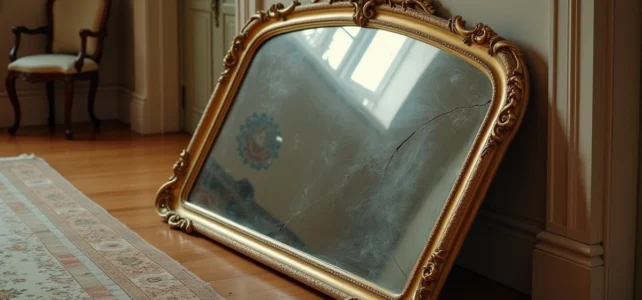
A mirror fixed to the wall for months, sometimes years, that falls without apparent reason: no vibration, no draft, no failing nail. This type of event has long fueled interpretations that go beyond simple material explanation. The spiritual significance of a mirror that falls on its own varies according to traditions, eras, and interpretative frameworks, from a dire omen to a signal of personal transformation.
Mirror that falls on its own: the energetic perspective rather than superstition
The superstition of seven years of bad luck associated with a broken mirror dates back to Roman antiquity, where the mirror was believed to capture the image of the soul. Breaking the reflection was akin to damaging the soul itself. This widely documented interpretation remains the dominant cultural reference in the West.
In recent years, another framework has emerged in online spiritual communities. On Reddit and TikTok, testimonies of mirrors falling without identifiable cause (often reported around 3 a.m.) are interpreted not as a forthcoming misfortune, but as a surge of energy linked to repressed emotions. This “energetic” interpretation associates the object’s fall with an emotional saturation of the space or the person living there.
When seeking to understand the spiritual meaning of a mirror that falls on its own, one quickly encounters this distinction between the old punitive superstition and the contemporary reinterpretation focused on the energy of the place.
Field reports diverge on this point: some practitioners of purification rituals (sage, salt) report a calming effect after the fall, while others see it as merely a mechanical coincidence. No study can definitively conclude, but the cultural shift is real.

Positive reinterpretation of the broken mirror: sign of spiritual renewal
The reversal of superstition is one of the most documented phenomena in recent French esoteric blogs. The idea that breaking clear glass marks a transition to a new reality is increasingly circulating. According to this interpretation, the object would have “taken the hit for you,” absorbing a negative charge to prevent more serious harm to its owner.
The site Passeurs d’Espérance dedicates an article to broken white glass as a sign of luck and renewal, in direct opposition to the tradition of seven years of bad luck. This approach fits into a broader trend where the end of a protective object (mirror, glass, crystal) is read as the end of an obsolete protection cycle.
The mirror as a symbolic shield
From this perspective, a mirror is not just a decorative object. It is seen as a sensor of ambient energies, a filter between the inside and the outside. Its fall would signal that this filter has reached its limit, that it has “filled up” with what it was meant to absorb.
Recent spiritual guides, inspired by feng shui and Japanese practices, link the spontaneous fall of objects (not just mirrors) to a message from the environment. The mirror, by its reflective nature, occupies a unique place: it reflects the image of oneself, and its destruction is read as an invitation to reconstruct that image.
Psychology and broken mirror: when the symbol meets the inner framework
Modern psychology increasingly uses the broken mirror as a clinical metaphor. An inner framework that is cracking, a self-image that no longer holds, a period of deep questioning: the falling mirror materializes a symbolic rupture already in progress.
This interpretation does not necessarily oppose the spiritual one. It complements it by proposing a mechanism: selective attention. Faced with a mundane event (an adhesive that gives way, a nail that yields under weight), a person in a period of emotional transition will imbue the event with a meaning that corresponds to their inner state.
Projection or signal: the limits of interpretation
The available data do not allow us to conclude that a mirror falls “because of” an energy or emotion. However, the effect that this fall has on the person experiencing it is very real. Several axes deserve to be distinguished:
- Pure mechanical coincidence: a fixation defect, temperature variations, imperceptible vibrations of the building. This is the most common and verifiable explanation.
- Jungian synchronicity: an external event with no causal link to the inner state, but which resonates with it. The mirror falls at a moment when the person is going through a crisis, and this temporal coincidence becomes meaningful.
- The energetic or spiritual reading: the object reacts to a saturated environment. This hypothesis, not verifiable by current scientific tools, nonetheless structures the experience of many people.
None of these frameworks invalidate the others. They operate on different registers, and the choice of interpretation depends on the person’s frame of reference, not the event itself.

What to do after a mirror falls: concrete actions and rituals
Beyond interpretation, the fall of a mirror raises a practical question: how to react? Popular traditions and spiritual practices offer quite different responses.
- The Roman tradition suggests burying the pieces of the broken mirror to sever the link with the announced misfortune. Throwing a pinch of salt over the left shoulder is another common gesture.
- The practice of sage smudging, derived from Indigenous traditions and widely adopted by contemporary spiritual communities, aims to purify the space after the fall. The idea is to “reset” the energy of the place.
- Feng shui recommends not immediately replacing a mirror in the same spot. The position of the mirror in the home, facing a door or in a bedroom, is considered an aggravating or mitigating factor depending on the school.
The common point of these approaches is that physical action after the fall matters as much as interpretation. Picking up the pieces, cleaning the space, consciously deciding whether or not to replace the mirror are actions that allow one to regain control of the narrative, whether or not one believes in a spiritual dimension.
A falling mirror remains a disturbing event, even for the most rational. What distinguishes the different readings is not their degree of truth, but their function: to provide a framework for an experience that temporarily escapes control. Whether this framework is mechanical, psychological, or spiritual, it serves the same role of reappropriation.