
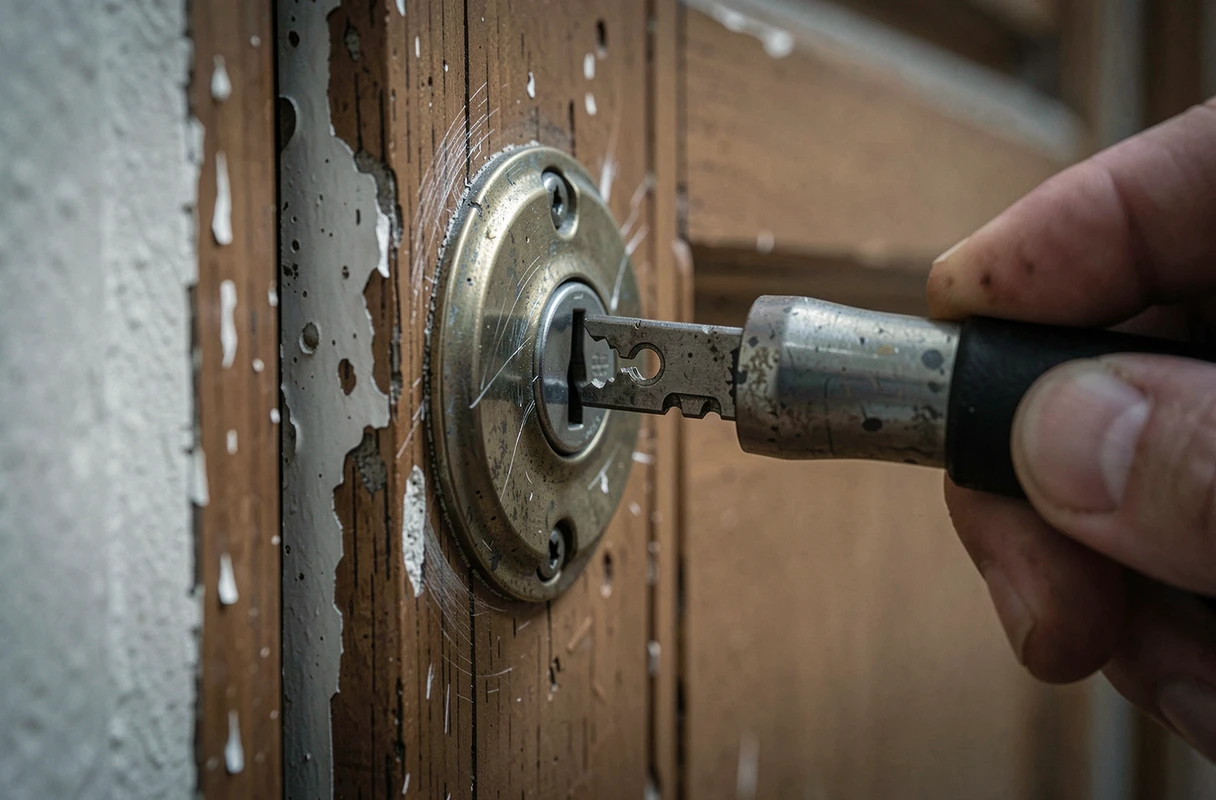
When a lock cylinder breaks, the first question is not whether to call a locksmith. It’s to understand what remains in the mechanism and how the condition of the fragment guides the extraction method. A visible piece of key is not treated at all like a fragment broken flush with the rotor, and confusing the two situations often worsens the damage to the cylinder.
Visible, flush, or invisible fragment: three scenarios, three methods
The visual diagnosis conditions everything that follows. Before touching the mechanism, one must carefully observe where the broken piece is located in the cylinder.
| Situation | What we see | Suitable tool | Difficulty |
|---|---|---|---|
| Fragment protruding from the cylinder | Several millimeters of metal stick out from the key entry | Needle-nose pliers | Low |
| Fragment flush with the rotor | Nothing protrudes, but the metal is visible at the bottom | Broken key extractor (hook or spiral) | Medium |
| Invisible or deeply stuck fragment | No visible metal, the rotor no longer turns | Cylinder drilling or complete removal | High (professional intervention recommended) |
In the first case, needle-nose pliers are usually sufficient if you pull along the axis without forcing sideways. The second case requires a key extractor, a fine toothed tool that is inserted along the fragment to hook it and pull it towards you.
The third scenario is the one that traps the most DIYers. Forcing with a screwdriver or an unsuitable object deforms the internal pins and turns a lock cylinder break repair that is simple into a complete mechanism replacement.

Removing the broken cylinder: the retaining screw and the alignment of the cam
A common mistake occurs in the majority of failed attempts. The DIYer removes the retaining screw of the cylinder (visible on the edge of the door, at the level of the lock) but forgets to align the cam before pulling.
The cam is the small metal lever that protrudes under the cylinder. When the door is closed, the cam must be perfectly horizontal for the cylinder to slide out of the housing. If the remaining key fragment still allows for slight rotation, it must be turned to align this lever. Otherwise, the removal will be blocked.
Correct removal sequence
- Completely remove the retaining screw located on the edge of the door, at the level of the lock housing. Do not just loosen it.
- Turn the key fragment (or use a thin screwdriver in the rotor) to bring the cam into a horizontal position, parallel to the cylinder.
- Push the cylinder from the outside or pull it from the inside. If it resists, check that the screw is fully removed and that the cam is not catching on the housing.
A misalignment of the cam can block the door once closed, even with a new cylinder. This point is often underestimated in most tutorials that focus on key extraction.
Choosing a replacement cylinder: dimensions and security level
Replacing a broken cylinder with an unsuitable model is equivalent to repairing for nothing. Two parameters determine compatibility.
The first is the total length of the cylinder. It is measured from each face of the door to the center of the retaining screw. A cylinder that is too long protrudes from the rose and becomes vulnerable to being pulled out. A cylinder that is too short prevents the key from reaching the mechanism.
The second parameter is the level of resistance. European cylinders are classified according to the EN 1303 standard, which assesses resistance to picking, drilling, and breaking. However, not all cylinders sold in supermarkets meet the same requirements. Entry-level models often offer no anti-drilling or anti-picking protection.
Safety criteria to check before purchase
- Anti-drilling protection: a hardened steel pin in the body of the cylinder prevents the passage of a drill bit.
- Anti-picking protection: security pins (mushroom or spool) complicate manipulation by an intruder.
- Anti-pulling protection: a steel reinforcement around the key entry resists pliers.
- Ownership card: some manufacturers provide a coded card without which no key duplication is possible.
A cylinder with an ownership card prevents any unauthorized key duplication. This detail is as important as the physical resistance of the cylinder, especially after a burglary or loss of keys.
Lubricant for lock cylinders: what protects and what clogs
After replacement, the question of maintenance arises immediately. The choice of lubricant determines the lifespan of the new cylinder.
Graphite powder and silicone lubricant are the two products suitable for a cylinder mechanism. They do not attract dust and do not leave a sticky residue inside the rotor.
Thick oils and multipurpose greases have the opposite effect. They capture dust particles and gradually create a paste that jams the pins. WD-40, often used reflexively, poses a similar problem in excess: its oily film retains micro-debris over the long term.
A dry lubricant application every month at the key entry is sufficient to maintain the fluidity of the mechanism. The operation takes a few seconds and prevents most blockages that lead to breakage.
Repairing a broken cylinder remains accessible as long as the sequence is respected: diagnosis of the fragment, clean removal with cam alignment, choice of a cylinder with the correct dimensions and appropriate security level. The only situation that justifies an immediate call to a locksmith is an invisible fragment stuck deep in a rotor that no longer turns, as forcing at this stage damages the lock housing itself.