
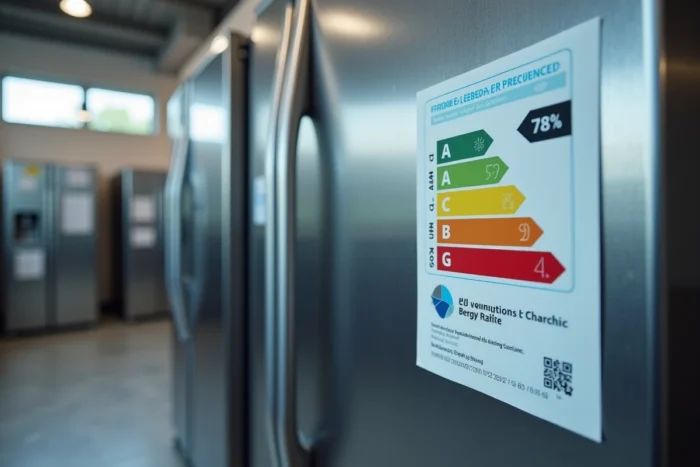
Since March 2021, the energy label for refrigerators has been completely overhauled by the European Union. The old scale of A+++ to D, which became unreadable due to the accumulation of “+”, has been replaced by a stricter rating from A to G. For anyone buying a fridge in 2025 or 2026, the instinct to aim for the “best letter” needs to be nuanced: class A is intentionally almost empty, and the truly relevant choice depends on factors that the label alone does not summarize.
F-Gas III Regulation and Refrigerants: What Changes for Your Future Fridge
The energy class measures electricity consumption, but it says nothing about the gas circulating in the cooling circuit. The European F-Gas III regulation, adopted in 2024, imposes a schedule for reducing high global warming potential (GWP) fluids used in domestic refrigeration.
Specifically, manufacturers must transition to low GWP refrigerants by the end of the decade. Some models sold today still use gases that will be restricted. Buying a fridge that performs well on paper but is equipped with a fluid that will soon be regulated poses a medium-term maintenance issue: if the circuit needs to be recharged in five or six years, the original gas may no longer be available or its cost may have significantly increased.
Before comparing the letters on the label, checking the type of refrigerant (often indicated in the technical sheet under R-600a, R-290, or R-134a) provides information that the energy class alone does not offer. Models operating on R-600a (isobutane) or R-290 (propane) are already compliant with future requirements, which secures the lifespan of the appliance.
A detailed guide on the energy class of fridges on Maison Créa allows for cross-referencing these technical criteria with consumption data to refine your choice.
Actual Energy Class of the Fridge: Why A Doesn’t Make Sense in 2025
The current scale has been calibrated so that class A remains intentionally empty at launch. The European Commission’s goal was clear: to leave room for technological progress and avoid replicating the congestion of the old A+, A++, and A+++ categories.
In practice, the vast majority of the available offer in stores falls between classes C and F. The most efficient models on the market reach class B, sometimes C for large volume combined refrigerators. An old A+++ can now be classified as C or D according to the new measurements.
The Trap of Marketing Overclassification
Some retailers continue to display the old rating alongside the new one to give an impression of superior performance. A fridge sold with the mention “ex-A+++” in class D has not changed its consumption: it is the scale that has become more demanding. A model rated B or C today represents the top of the truly accessible range.
The available data does not allow us to conclude that a class B fridge will always be more cost-effective than a C over ten years, as the price difference at purchase varies greatly depending on brands and embedded technologies (ventilated cooling, inverter compressor).
Consumption in kWh and Real Cost by Energy Class
The energy label indicates the annual consumption in kWh, calculated under standardized laboratory conditions. This data remains the most reliable criterion for comparing two refrigerators of equivalent volume.
- A combined refrigerator of class B consumes significantly less than a model of class E or F, with a gap that can represent several dozen euros per year on the electricity bill.
- A fridge of class A consumes about three times less than a class G model, but these devices remain rare and significantly more expensive to purchase.
- The type of cooling influences actual consumption: a No Frost model (ventilated cooling) consumes more than a static cooling model at the same class, as the fan runs continuously. However, it prevents frost, which maintains the compressor’s efficiency over time.
- The volume of the fridge directly impacts consumption. A 400-liter appliance in class C can consume as much as a 250-liter one in class E. Adapting the volume to the actual size of the household remains a frequently underestimated savings lever.
Comparing two fridges solely by their letter without checking the volume and cooling technology is akin to comparing two cars by their color.
Fridge Class C or Class D: The Real Price-Consumption Trade-off
For the majority of households, the choice lies between classes B, C, and D. Class B offers the best accessible efficiency, but the price difference with a class C model can reach several hundred euros depending on the brand and volume.
The amortization of this gap depends on the lifespan of the appliance. A fridge typically remains in service for between ten and fifteen years on average. Over this period, the difference in annual consumption between a class C and a class D translates into cumulative savings that may justify the initial extra cost, or not, depending on the electricity rate applied.
What the Label Doesn’t Show
The 2021 energy label includes additional useful information beyond the letter: the noise level in decibels, the usable volume of each compartment, and a QR code linking to the European EPREL database. This public database allows for verification of the data declared by the manufacturer and comparison of models based on standardized criteria.

Choosing an energy class for a refrigerator is not just about aiming for the highest letter. A fridge of class B or C, suited to the actual volume of the household, equipped with a refrigerant compliant with future F-Gas standards and purchased at a price consistent with the expected amortization period, constitutes a more solid purchase than an overclassified model on paper but oversized or technically outdated.