
The development of a child simultaneously involves language, motor skills, emotional regulation, and social abilities. These dimensions progress at different rates depending on age, temperament, and family environment. Supporting this progression requires understanding some documented mechanisms, rather than multiplying activities without a clear reference.
Screens before age 3 and language development: what cohorts show
The recommendation “no screens before age 3” is widely circulated, but the data supporting it deserve clarification. The French Elfe study and summaries from INSERM highlight a significant increase in attention and language disorders among children exposed daily to screens before age 3.
The national program “The First 1000 Days,” updated in 2023 by the Ministry of Solidarity and Health, emphasizes this risk even when the viewed content is labeled “educational.”
The issue is not solely about content. An active screen in the background reduces the number of verbal interactions between the adult and the child. Yet it is precisely the quantity and quality of these direct exchanges that fuel vocabulary acquisition between 12 and 36 months.
Several resources compile concrete approaches to replace screen time with activities suitable for each age group. Parents share their feedback and questions on the Parenting Advice for Children website, which gathers suggestions categorized by developmental stage.
However, field reports diverge on one point: at what age does occasional and supervised use (a parent commenting on what is happening on screen) cease to be problematic? The available data do not allow for a universal threshold. The determining variable seems to be the active presence of the adult during viewing, not just the duration.
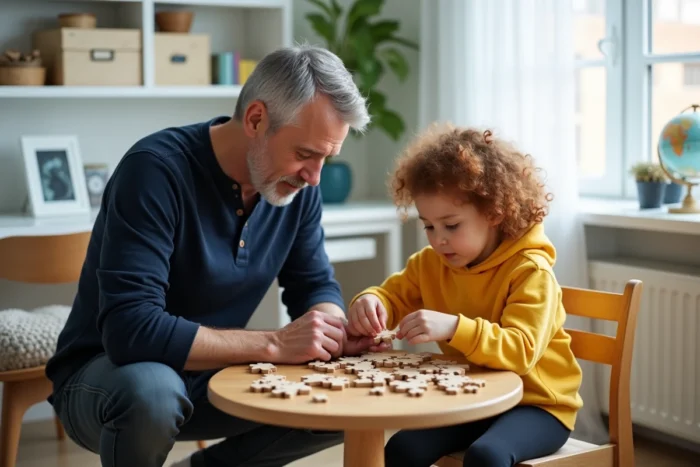
Stable family routines: an underestimated protective factor
Competitors often mention the “nurturing framework” without explaining what it concretely consists of. Public health guides, particularly the Quebec recommendations on the overall development of the child, document a link between predictable routines and a reduction in sleep disorders in children aged 0 to 6 years. Regular meal times, bedtime rituals, and quiet time after intense activity: these temporal markers also reduce behavioral problems.
The mechanism is not mysterious. A child who knows what comes next expends less energy managing uncertainty. This cognitive economy frees up resources for exploration, play, and learning.
Building a routine without rigidity
An effective routine is not a military schedule. It relies on a few anchor points throughout the day:
- A consistent wake-up ritual and bedtime ritual every day, even on weekends, that stabilizes the child’s circadian rhythm
- A daily moment of free play without educational objectives, where the child chooses their activity and pace
- A shared reading time, even brief, that combines physical closeness, listening, and vocabulary enrichment
Adaptation remains necessary. A tired or sick child needs flexibility. Regularity matters more than rigidity: maintaining three stable markers out of five is enough to produce a protective effect.
Educational methods at home: what works by age
Multiplying workshops and educational tools guarantees nothing if the level of difficulty does not match the child’s developmental stage. Before age 3, learning occurs almost exclusively through sensory manipulation and repetition. Stacking, pouring, or tactile exploration games engage fine motor skills and hand-eye coordination much more effectively than a tablet app.
Between ages 3 and 6, during preschool, free play remains the main driver of learning. Directed activities (coloring, cutting, first drawings) complement this foundation but should not replace it. A 4-year-old spending an hour building a fort with cushions is working on planning, problem-solving, and negotiation with peers.
Homework and school learning after age 6
The transition to first grade introduces homework at home. The temptation is strong to turn this moment into an intensive session. Data on intrinsic motivation show that pressure on academic results reduces the pleasure of learning in the medium term.
Some documented principles help preserve this momentum:
- Limit homework time to a duration appropriate for the age, breaking tasks into short blocks with breaks
- Value the process (the strategy used, the effort of thinking) rather than the final result
- Allow the child to encounter mistakes before intervening, as it is the gap between prediction and outcome that consolidates learning
- Pair a physical or manual activity before or after homework to regulate attention

Adult voice and child’s emotional regulation
The tone and volume of the parental voice directly influence the child’s ability to regulate their own emotions. This link, often reduced to “don’t shout,” deserves clarification. A calm voice and slow pace activate the child’s parasympathetic system, which slows down excitement and promotes a return to calm.
Conversely, repeated shouting generates what developmental psychology researchers call “permanent toxic stress”, which affects emotional regulation and long-term learning.
This does not mean that a parent should remain impassive. Naming one’s own emotions out loud (“I am frustrated because…”) teaches the child an emotional vocabulary they can reuse. This technique, derived from positive discipline, works best when practiced regularly, not just during crises.
Supporting a child’s development relies less on accumulating activities than on the quality of a few repeated gestures: speaking directly, maintaining stable markers, adjusting expectations to the child’s actual age, and moderating screen use while being present. These levers require neither expensive materials nor patented methods, but regular attention to the signals the child sends.