A laboratory ships a batch of vaccines from its production site. Between the loading dock and the hospital pharmacy, this batch passes through several hands, multiple vehicles, and sometimes various climatic zones. At each stage, the temperature must remain stable, traceability must follow, and regulations must be respected. It is on this complex chain that the quality of the medication delivered to the patient is at stake.
Pharmaceutical Traceability: From Package Tracking to Batch Proof
For a long time, tracking a pharmaceutical shipment meant locating a package along a route. Knowing it left the warehouse at 8 AM and arrived at its destination by 2 PM was enough to provide reassurance.
This approach no longer meets current expectations. Recent practices recommend associating each temperature reading with a specific batch, not just with a container. If a thermal excursion occurs during transport, the decision to maintain or isolate the product must be documented and linked to the relevant batch number.
In practical terms, this means that a logistics provider must keep a record of non-conformities and retain proof of the decision made after each incident. A healthcare professional receiving the batch can then verify, after delivery, that the product has indeed traveled under the required conditions. Traceability becomes a proof tool, not just a tracking tool.
For laboratories and distributors, this requirement transforms the choice of logistics partner. It is no longer just about speed or geographical coverage. Pharmalog’s services integrate this logic by linking transport data, batch identification, and quality event management on a single information chain.

Extended Responsibility of Producers and Pharmaceutical Packaging
Have you ever noticed the amount of packaging generated by a single pallet of medications? Boxes, plastic films, thermal cushioning, leaflets: each layer protects the product but also creates waste.
Since recent developments in extended producer responsibility (EPR), companies in the healthcare sector have additional obligations. They must, in particular:
- Identify themselves to an approved eco-organization and formally join it
- Declare the volumes of professional packaging placed on the French market each year
- Pay the corresponding eco-contributions, calculated according to the type and weight of materials
This topic often remains absent from discussions on pharmaceutical logistics, where attention focuses on transport and storage. EPR adds a distinct obligation to the usual traceability. A logistics provider that also manages packaging and repackaging must integrate this constraint into its processes, or risk leaving the client laboratory in violation.
For a professional outsourcing their logistics, ensuring that their partner handles the declaration and management of packaging avoids a significant administrative burden.
Pharmaceutical Storage in France: Temperature Constraints and Regulatory Framework
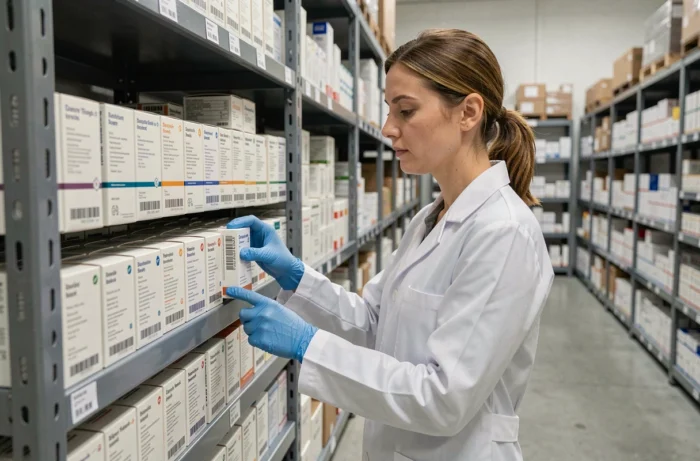
Storing medications is not like the conventional storage of goods. A pharmaceutical warehouse must comply with Good Distribution Practices (GDP), which impose precise conditions for temperature, hygiene, and product separation.
Continuous Monitoring of Storage Areas
Temperature sensors are not just for displaying a number on a screen. Each storage area must be thermally mapped to identify hot and cold spots. This mapping allows the most sensitive products (vaccines, insulins, certain antibodies) to be placed in the most stable locations.
Monitoring operates continuously, with automatic alerts in case of threshold breaches. A timestamped record is kept for each area, allowing proof to be provided afterward that conditions were maintained.
Separation of Flows and Status Management
A pharmaceutical warehouse simultaneously manages released products, products in quarantine, and sometimes returned or recalled products. Mixing these flows constitutes a serious non-conformity. The logistics provider must therefore have physically separated areas or, failing that, a computer system that locks access to unreleased batches.
This constraint directly impacts the size and organization of the warehouse. A pharmaceutical storage site consumes more usable space than a general warehouse of equivalent volume because the separation of statuses multiplies dedicated areas.

Cold Chain and Transport of Health Products: Critical Points
Transport remains the most exposed link in the cold chain. Why? Because it is the moment when the product leaves a controlled environment (the warehouse) to traverse variable conditions.
The critical points focus on three moments:
- Loading, when the product moves from the cold room to the vehicle and undergoes a potential first thermal shock
- Breaks in the load, during transfers between vehicles or at intermediate platforms
- The final delivery, often carried out by a delivery person who opens and closes the vehicle doors at each stop, exposing the contents to outside temperature
A HACCP-type control plan adapted to cold transport allows for the identification of these critical points and defines the corrective measures to be applied. For example, imposing a maximum door opening time for the vehicle or using thermal packaging for multiple deliveries on the same trip.
For products subject to the ATP standard (agreement on the transport of perishable goods), the vehicle itself must be certified and periodically controlled. This standard, well known in the agri-food sector, also applies to certain thermosensitive pharmaceutical products.
The choice of a pharmaceutical logistics provider largely hinges on their ability to document these steps. A laboratory or wholesaler that entrusts its health products to a third party retains regulatory responsibility for the product. Outsourcing transport does not transfer quality responsibility. The contract with the provider must specify who measures, who records, who decides in case of an excursion, and who retains the evidence.
This last point changes the way professionals select their logistics partners. The price per package matters, but the robustness of the proof system is even more important when a batch is subject to inspection or recall.