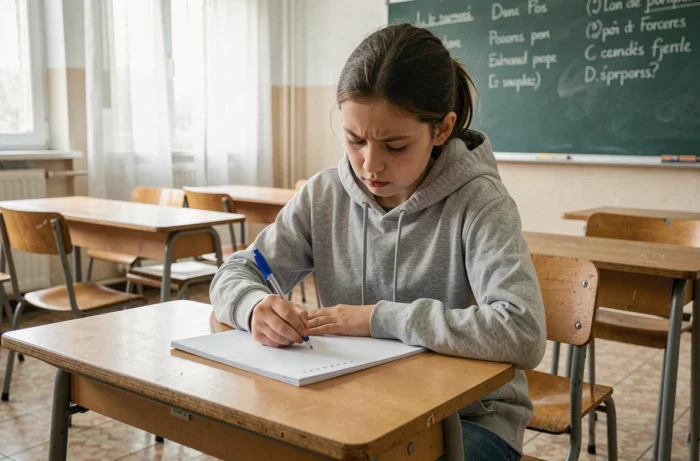
Writing in 6th grade is based on a specific exercise: producing a structured text (narrative, descriptive, or argumentative) while adhering to guidelines regarding length, coherence, and linguistic accuracy. Improving writing skills requires practice on various topics and systematically analyzing corrections to identify recurring mistakes.
Structuring a narrative in 6th grade: the skeleton before the style
The majority of papers lose points not due to spelling, but due to the organization of the text. A 6th-grade student writing a narrative must master three blocks: the initial situation, the disturbing element, and the resolution. Without this framework, even a rich vocabulary is not enough.
An effective topic to work on this point: “Tell about an ordinary day that changes due to an unexpected event.” The correction must then check that each block is identifiable, that temporal connectors (first, suddenly, finally) ensure progression, and that the text does not stop abruptly.
To consult 6th grade writing topics with corrections ready to use, there are resources that detail each step of narrative construction with annotated examples.
Working on structure does not mean stifling creativity. The student learns to set a framework before filling it in, just as one outlines the walls of a house before choosing the paint.
Descriptive topics: enriching vocabulary through constraints
Description is the neglected sibling of writing exercises in middle school, often reduced to “Describe your room.” This type of topic produces flat texts because it imposes no lexical constraints.
A more productive topic imposes a specific rule. For example: “Describe an outdoor market without using the words ‘beautiful’, ‘big’, or ‘small’.” This constraint forces the student to seek synonyms, engage the five senses, and vary the adjectives.
What the correction should highlight
The correction of a descriptive exercise is not limited to providing a model text. It must identify typical errors:
- Lexical repetitions (the same adjective used three times in four sentences), with a replacement suggestion for each occurrence
- The absence of spatial organization (the student jumps from one detail to another without logical flow, from the foreground to the background, for example)
- Too long sentences that accumulate complements without punctuation, making reading confusing
A good annotated correction is worth more than ten topics without feedback. The student progresses when they understand why their sentence does not work, not just by reading a “correct” version.
Written expression and spelling: working on both together
Separating writing and spelling is a common but counterproductive habit. In a real writing situation, the student must simultaneously manage content (ideas, flow) and form (agreements, conjugation, homophones).
A topic that combines both: “Write a short story in the simple past using at least five verbs from the second group.” This type of instruction targets a specific conjugation point while maintaining narrative demands.
The correction then serves a dual function. It first evaluates the coherence of the narrative, then points out errors in simple past conjugation, distinguishing those that stem from a lack of knowledge of the rule and those that are mere oversights.
Three types of topics to improve spelling through writing
- The narrative constrained by a verb tense (writing exclusively in the narrative present, or alternating imperfect and simple past)
- The portrait with the obligation to correctly agree at least six adjectives with their noun
- The fictional letter to a character, which imposes the formal “vous” and thus mastery of the second person plural endings
These exercises work because they provide a measurable grammatical objective within a free text. The student is not doing a fill-in-the-blank exercise: they are writing a real text with a rule to follow.
Guided proofreading: the forgotten skill of writing corrections
Most 6th-grade students do not proofread their work, or they proofread without a method. The correction can include a proofreading checklist that transforms this step into a concrete habit.
An effective checklist includes four distinct checks, in this order: subject-verb agreements, agreements within the noun group, grammatical homophones (a/à, et/est, son/sont), and then punctuation. Proofreading four times while focusing on a single point each time yields better results than a single vague proofreading.
This method can be practiced from 6th grade with short topics. A ten-line text is enough to establish the reflex. The correction then shows the errors that each proofreading pass would have caught, making the method tangible for the student.
The challenge of writing in 6th grade is not limited to producing a text without mistakes. Learning to structure ideas, choose words under constraints, and proofread methodically builds skills that serve well beyond the French class. The detailed correction remains the most underutilized lever: it is by analyzing what does not work in their own text that a student makes lasting progress in writing.