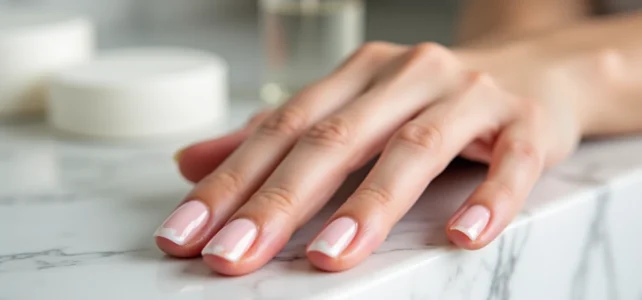
A semi-permanent is removed after three weeks, and the nail underneath is white, dull, almost chalky. The classic reaction: thinking of a fungus or a calcium deficiency. In most cases, the problem lies elsewhere. The keratin plate has undergone mechanical stress and a loss of hydration related to the application itself, not to a fungus or a dietary deficiency.
The polish does not protect the nail: understanding keratin dehydration
It is often said that polish forms a “shield” on the nail. In practice, the opposite happens during application and removal. The prior filing, polymerization under UV or LED light, and then removal (file, acetone, drill) stress the surface of the plate at every step.
The whitening observed after removal usually corresponds to a dehydration of the keratin plate. The nail loses some of its water and natural fats, which alters how light passes through the surface. The result: a milky, opaque appearance, sometimes grainy to the touch.
Nail professionals are increasingly documenting these effects and confirming that the majority of damage is mechanical, not chemical. It is not so much the formula of the polish that is problematic but rather how it is applied and removed.
The phenomenon of white marks on nails after polish affects both salon applications and home kits, as soon as the removal is too aggressive or when applications are consecutive without a break.
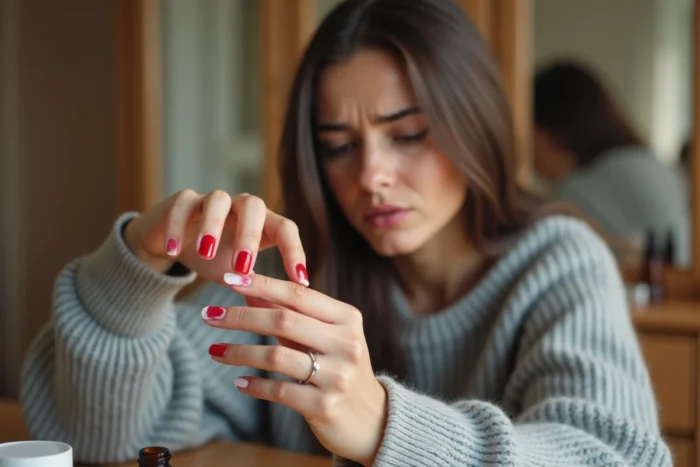
Duration of application and consecutive applications without breaks: the real risk factors
You can wear a semi-permanent or gel for two to three weeks without visible damage. The problem begins when you push the removal to four or five weeks, or when you directly follow up with a new application on a nail that hasn’t had a chance to breathe.
Why the duration of application worsens whitening
The longer the polish stays on, the longer the plate is deprived of exchanges with the surrounding air. The keratin gradually dehydrates under the polymerized layer. At the time of removal, the nail appears even whiter the longer it has been worn.
Spacing out applications by at least a week allows the nail to naturally rehydrate. During this window, you can apply a vegetable oil (castor, jojoba, sweet almond) directly on the plate and cuticles, morning and evening.
Removal, the most critical step
Scraping off a semi-permanent polish that is still sticking, forcing with a metal cuticle pusher, or filing too deeply: these actions tear away the superficial layers of keratin. You end up with a thinned, whitened nail, sometimes painful to the touch of water.
Feedback varies on this point, but gentle chemical removal (cotton soaked in non-acetone remover, held under aluminum foil) remains less traumatic for the plate than complete filing with an electric file.
White spots on nails after manicure: distinguishing dehydration, residues, and fungus
Not all white marks are the same. Knowing how to differentiate them prevents treating a benign issue as an infection, or vice versa.
- Post-removal dehydration: the entire nail appears milky, uniform. The pink color gradually returns within a few days with regular hydration. This is the most common case.
- Residues from base or pigments: localized white marks, often near the free edges or cuticles. A very light buffing with a four-sided block is usually enough to remove them.
- Micro-traumas (punctate leukonychia): small, well-defined white spots, often round, that grow out with the nail. They result from a shock to the matrix and disappear on their own within a few weeks.
- Fungus (onychomycosis): the nail thickens, yellows, or takes on a greenish hue, sometimes accompanied by an odor. The spot does not migrate with growth. This case requires medical advice, ideally from a dermatologist.
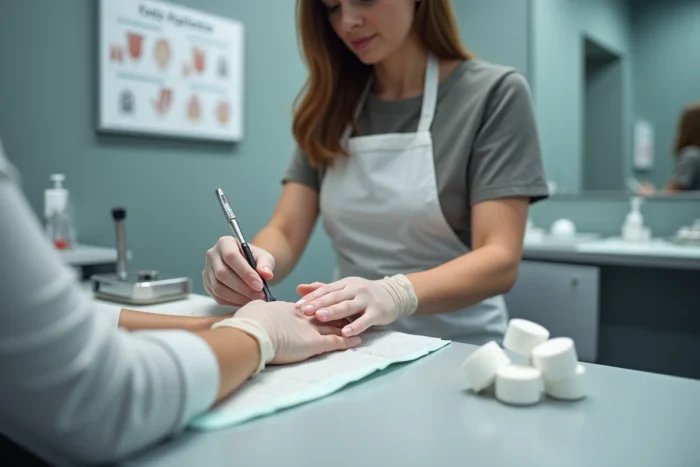
If whitening persists beyond two weeks despite hydration, or if it is accompanied by pain, detachment, or thickening, consulting a dermatologist allows for ruling out an underlying pathology (fungus, liver damage, inflammatory disease).
Recovery care for white nails after semi-permanent polish
Recovering a dehydrated nail generally takes the time of a complete growth cycle, which is several months. You can speed up the return to a normal appearance with a few simple gestures.
- Apply a nourishing oil daily to the plate and cuticles. Jojoba penetrates well into keratin, while castor adds thickness to the lipid film.
- Avoid pure acetone removers, which worsen dehydration. Prefer non-acetone formulas or those enriched with moisturizing agents.
- Limit filing to the strict necessary during the next applications. A light buffing is sufficient for primer adhesion.
- Wear gloves for dishwashing and cleaning: hot water and detergents accelerate the loss of lipids from the plate.
In terms of diet, leukonychia related to a deficiency (zinc, iron) does exist but is less common than mechanical dehydration. If the diet is varied, there is no need to supplement without medical advice.
Adopt a more spaced-out manicure routine
The current trend in salons and on social media is towards a healthier manicure as an aesthetic norm, not just as a one-time precaution. Alternating classic polish and semi-permanent, leaving nails bare for a week between applications, choosing brands formulated without the most drying ingredients: these habits significantly reduce the risk of recurring whitening.
A nail that whitens after removal sends a clear signal: the plate needs rest and hydration. The problem almost always comes from application habits, not from natural fragility or deficiency. Adjusting the pace of manicures and caring for removal is enough, in the vast majority of cases, to restore pink and smooth nails without resorting to medical treatment.