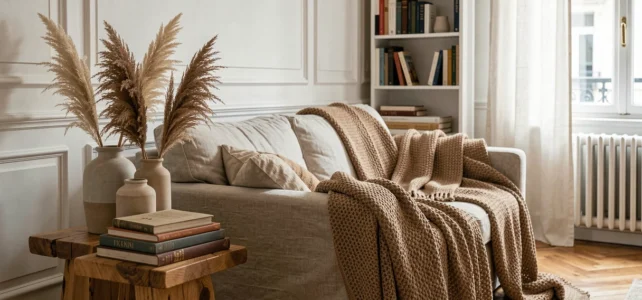
Creating a warm and contemporary interior is not just about piling cushions on a sofa. Recent decor trends show a clear shift towards sustainable materials, minimalist aesthetics, and a growing focus on the energy performance of homes. These three parameters are redefining what it means to have a cozy home in every season.
Solid wood and Japandi style: the foundation of a warm, sustainable interior
Decor articles often talk about neutral colors and plush throws. They frequently overlook an underlying movement that has been shaping the furniture market for several seasons: the return of solid wood combined with Japandi aesthetics. This blend of Japanese minimalism and Scandinavian simplicity creates interiors where warmth comes not from accumulation, but from the quality of the selected pieces.
French manufacturers of designer solid wood furniture, such as Drugeot, document this convergence in their recent publications. The principle is based on a few simple-lined pieces, made locally, that anchor the ambiance of a room without overwhelming it. A raw oak table, a softly edged sideboard, and an asymmetrical wall shelf are enough to set the scene.
The advantage of this approach is its longevity. A solid wood piece ages well, patinas over time, and adapts to seasonal decor changes. Textiles are renewed around it, not the structure. On the site www.blog-vip.net maison, feedback confirms that investing in a few durable pieces is more coherent than renewing everything each season.
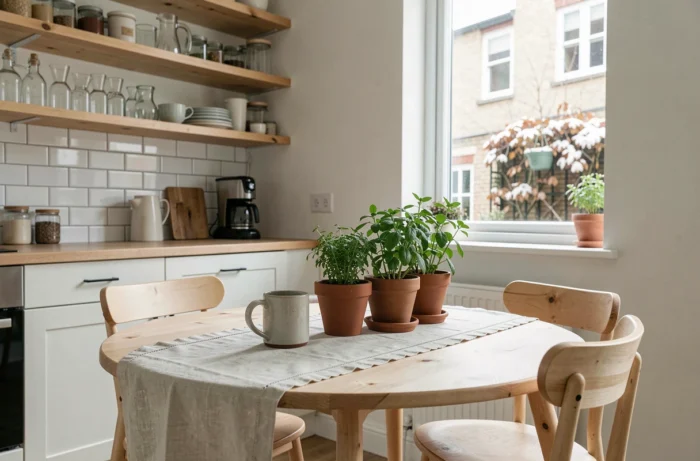
Energy performance and thermal comfort: what regulations change for decor
One aspect that decor guides almost never address is the impact of energy regulations on how to design a warm interior. The European EPBD 2024 directive (directive 2024/1275) requires member states to reduce the energy consumption of homes. France must transpose this text, which will accelerate thermal renovations.
In practice, this means that decor and layout choices increasingly interact with insulation constraints. A thick curtain in front of a poorly insulated window is no longer just a decor gesture; it is a thermal complement. The choice of flooring (parquet, cork, thick carpet) directly influences the feeling of warmth on a daily basis.
Adapting decor room by room to the energy diagnosis
Before choosing cozy materials, it may be useful to consult the energy performance diagnosis (DPE) of the home. The least insulated rooms deserve specific decor treatment: dense rugs on the floor, double curtains on north-facing windows, wooden furniture rather than metal (wood is naturally less conductive of cold).
This logic reverses the usual reflex. Instead of decorating first and compensating for cold later, we start from the thermal diagnosis to guide material and textile choices.
Textiles and natural materials: balancing aesthetics and maintenance year-round
Competitors consistently list linen, wool, and velvet. The real issue, as field feedback highlights, is managing these materials throughout the seasons. A beautiful velvet sofa in winter becomes stifling in July. A perfectly wrinkled linen in summer looks neglected in December.
Seasonal textile rotation is the most accessible lever to maintain a warm atmosphere without monotony. Here are the concrete trade-offs that work:
- Interchangeable cushion covers: washed linen or crinkled cotton from spring to autumn, boucle wool or corduroy from November to March. Two sets are sufficient.
- Thick knit throws stored from April to September, replaced by lightweight cotton throws. The gesture takes five minutes and transforms the atmosphere of a living room.
- Double-lined curtains in the cold season, sheer curtains alone in summer. This change alters both the light and the perceived insulation of the room.
A common trap is to accumulate textile layers without ever removing any. A warm interior in winter that remains the same in summer eventually appears heavy. Removing is also an act of decoration.
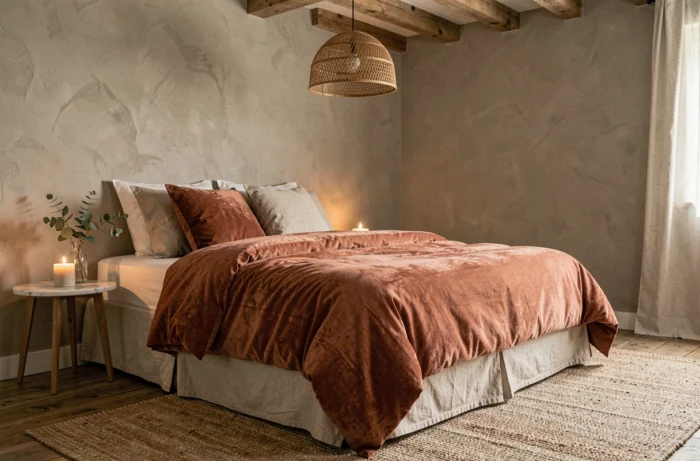
Lighting and green plants: two underutilized levers depending on the season
Lighting is often treated as a single subject, whereas it should vary as much as textiles. In winter, warm light (around 2,700 kelvins) enhances the cocoon effect. In summer, slightly more neutral bulbs prevent a feeling of confinement when the days are long.
Indoor plants: beyond just a green touch
Green plants bring a living dimension that no decor object can replace. Their role in regulating indoor humidity is documented, even if the available data does not allow for conclusions on a measurable impact in all homes. However, their visual effect is immediate.
The challenge lies in maintaining plants year-round. Tropical species (monstera, pothos, ficus) tolerate heated interiors well in winter. Succulents and cacti require less watering in summer. Mixing the two categories ensures a green interior without dry spells.
- Grouping plants by light zone rather than scattering them creates a warmer mass effect than an isolated pot on each piece of furniture.
- Varying heights (suspension, shelf, floor) adds depth to a space without adding furniture.
- Favoring pots made of natural materials (terracotta, wicker, raw ceramic) reinforces coherence with a decor oriented towards wood and fibers.
A warm home year-round is not a fixed decor. It is a space that adapts, where each season calls for a simple yet thoughtful adjustment of textiles, light, and greenery. Current trends, from Japandi to sustainable solid wood, facilitate this approach: they provide a stable framework around which everything else can move.