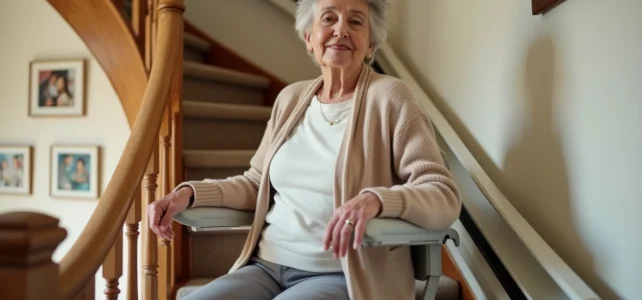
Stair width, maximum slope, load capacity, actual budget after aids: installing a stairlift involves technical parameters that commercial quotes do not always detail. This article compares measurable constraints to assess the feasibility of a project and its net cost after financing.
Minimum width and slope: the technical thresholds of a stairlift
The feasibility of an installation primarily depends on two physical measurements: the clear width of the staircase and its angle of inclination. These data vary according to the type of stairlift chosen.
| Type of stairlift | Minimum stair width | Maximum allowed slope |
|---|---|---|
| Straight | 67.9 cm (Stannah) | 55 to 70° depending on the ranges |
| Curved | 67.9 cm (Stannah) | Variable depending on the radius of curvature |
| Outdoor | 66.8 cm (Stannah) | Depends on the model and exposure |
| Standing (pole) | Approximately 65 cm | Suitable for very narrow staircases |
In older homes, staircases often fall below the 70 cm mark for usable width. A precise measurement before any quote avoids discovering incompatibility after the technical visit. The rail is fixed directly on the steps, not on the wall, preserving the structure of the building.
As detailed in a practical guide on 123 Docteur, the configuration of the staircase also conditions daily usability: a tight turn or an intermediate landing requires a custom rail, which has a direct impact on the price.
MaPrimeAdapt’ and financing a stairlift: what the aid actually covers
Since 2024, MaPrimeAdapt’ can cover up to 70% of the expenses for adapting the home, including materials and installation. The ceiling for elevation equipment (stairlift, private elevator, lifting platform) reaches €23,210 of eligible expenses.
The reimbursement rate depends on the household’s income. Households with the lowest resources benefit from the maximum rate, while intermediate incomes receive a smaller fraction. The remaining cost thus varies significantly from one project to another.
Several points deserve attention before relying on this scheme:
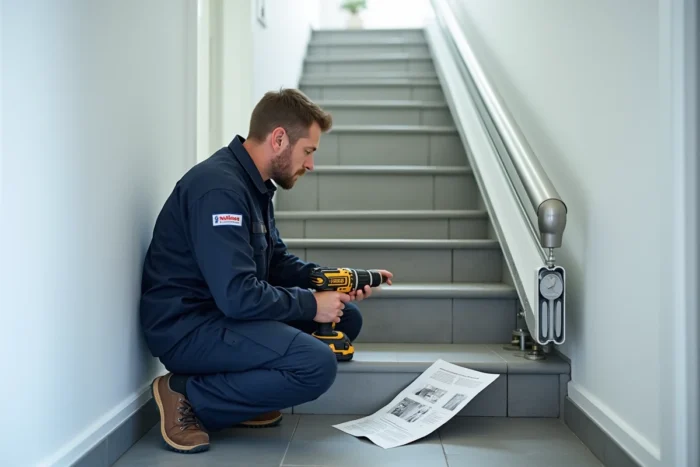
- The stairlift must be installed by a qualified professional for the expense to be eligible. Installation by a relative or self-construction does not qualify for any aid.
- The home must be the applicant’s primary residence, occupied for at least a year in most cases.
- The MaPrimeAdapt’ file must be submitted before the work begins. A signed quote or an already completed installation may lead to a refusal.
However, MaPrimeAdapt’ can be combined with certain local aids (departments, pension funds), which can further reduce the remaining cost. Checking the schemes available in your community before finalizing the financing is an essential step not to be overlooked.
Straight or curved stairlift: price difference and installation constraints
The choice between a straight model and a curved model is not based on aesthetic preference. It is the geometry of the staircase that dictates the solution.
A straight stairlift uses a straight rail fixed on the steps, without any special adaptation. The manufacturing is standardized, the delivery time is short, and the cost is significantly lower than that of a curved model.
A curved stairlift requires a custom-made rail, tailored to each turn, slope change, and intermediate landing. Taking measurements requires a thorough technical visit, and the manufacturing of the rail can take several weeks. This custom work explains a price difference that can range from simple to double compared to a straight model.
For staircases with a single quarter turn at the bottom or top, some manufacturers offer pre-curved rails that reduce the time and cost. This intermediate option is not suitable for spiral staircases or configurations with multiple landings.
Electrical safety and battery operation: a often underestimated point
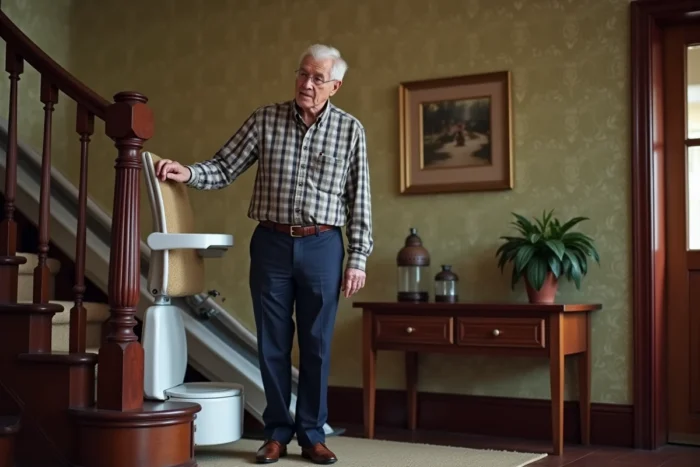
A stairlift operates on a rechargeable battery, powered by the mains via the rail or a wall socket depending on the models. This operation ensures that the equipment remains operational even in the event of a power outage.
The battery automatically recharges when the seat is parked in the high or low position, on its stopping points. Leaving the seat in the middle of the staircase after use prevents recharging and ultimately immobilizes the stairlift.
In terms of safety, models sold in France integrate several devices:
- Obstacle detector on the rail, which stops the movement if an object blocks the passage.
- Safety belt integrated into the seat, sometimes complemented by a lockable footrest.
- Continuous pressure control: the seat only moves as long as the user holds the button down.
- Key lock to prevent unauthorized use, especially by young children.
These devices are standardized across most ranges. The difference between models lies in the speed of movement, maximum load capacity, and noise level during operation.
Scams and abusive commercial practices around stairlifts
The stairlift market attracts aggressive sales practices, widespread enough to have prompted specific alerts. Some door-to-door sellers offer “stairlifts without work” at inflated prices, with unfavorable contractual conditions.
A strengthened regulatory framework now governs these practices. Door-to-door solicitation for this type of equipment is subject to a withdrawal period, and any contract signed during an unsolicited visit can be canceled within the legal deadlines.
Comparing at least three detailed quotes (materials, installation, warranty, maintenance) remains the most reliable way to identify an abnormal price. A quote that does not isolate the cost of the rail, the seat, and the labor lacks transparency.