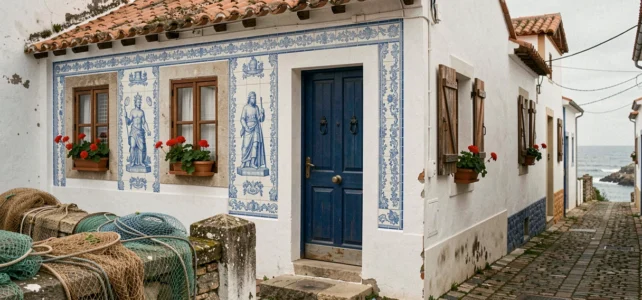
On the ground, a fisherman’s house in Portugal is quickly recognizable: thick lime-washed walls, a steep roof, modest size, often tucked away in a narrow alley just steps from the port. This visual charm does not guarantee anything about the legal solidity of the property or its ability to retain value in ten years.
Between vague permitted use, strict renovation constraints, and rental potential sometimes blocked by regulations, one can pay a high price for a property that depreciates immediately upon signing.
Permitted use and municipal license: the first filter before any visit
Before falling for the charm of an azulejo facade, it’s essential to check what the town hall actually allows for the property. In Portugal, major works, extensions, and reconstructions go through municipal control. For classified buildings or those located in protected areas, a full license is required.
In practical terms, this means that an “authentic” fisherman’s house in a coastal village may be subject to restrictions that prevent any structural modifications. No extensions, no raising of the roof, and sometimes not even a change of joinery without prior validation. A picturesque property but legally locked properties lose value upon resale, because the next buyer will inherit the same constraints.
The reflex to adopt: request the caderneta predial (land registry document) and the certificate of use of the property from the local câmara municipal. One seeks to know if residential use is confirmed, if previous works have been declared, and if the property is located within a heritage or environmental protection perimeter. When looking to find a fisherman’s house in Portugal that retains its value, this document speaks louder than any listing photo.
Renovation constraints in Portugal: what protects value and what undermines it
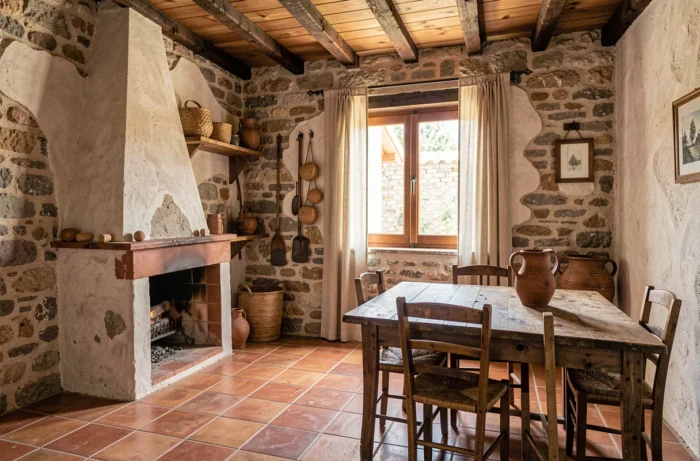
Renovating a fisherman’s house is not like refurbishing a Haussmannian apartment. The original materials (stone, wood, lime) impose specific techniques, and coastal municipalities closely monitor compliance with local architectural character.
Unreported works are the main factor of depreciation. An extension built without a permit, a roof modified outside the legal framework, a pool dug without authorization: all of this comes to light during an inspection or sale, and the potential buyer negotiates down, or even walks away. Feedback on this point varies by municipality, but the risk remains high along the coast.
For a renovation to protect the property’s value, it must check three boxes:
- Obtain the work license (licença de obras) from the câmara municipal before starting the project, including for significant interior modifications
- Comply with local architectural prescriptions, particularly regarding facade materials, ridge height, and colors allowed in classified areas
- Keep documented proof of each step (quotes, invoices, compliance certificates) to secure future resale
A properly renovated property, with a complete file, resells much better than a “newly done” house without any paperwork.
Legal rental potential: the AL license and its impact on value
The ability to legally rent a coastal property in Portugal radically changes its attractiveness in the market. The AL license (Alojamento Local), which allows for short-term tourist rentals, often enhances the appeal of a coastal property upon resale. A buyer who knows they can profit from the property in season is willing to pay more.
The regulatory framework has evolved in recent years. Some areas have tightened the conditions for obtaining licenses, while others have frozen new licenses in saturated neighborhoods. Before buying, one should check directly with the town hall if the property is eligible for an AL license or if an existing license is transferable.
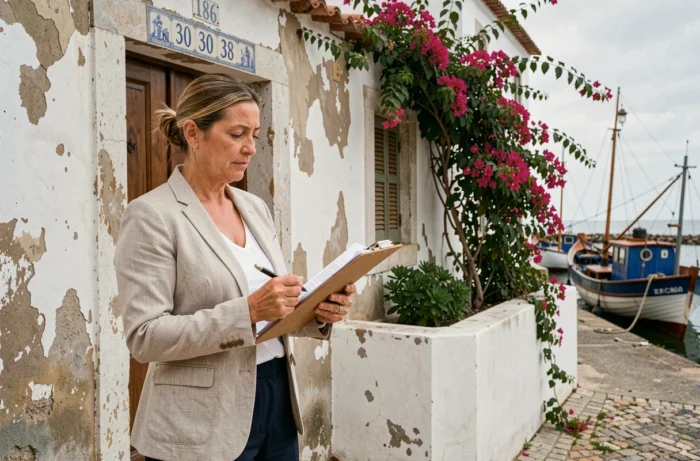
A often overlooked point: an already active and transferable AL license significantly increases the value of the property compared to an identical property without a license. In areas where new licenses are blocked, this license becomes an asset in itself.
Algarve, Comporta, Alentejo coast: where scarcity supports prices
Not all fisherman’s houses are equal depending on their location. The Algarve remains one of the most expensive markets in the country, with several sub-zones above the national median. A fisherman’s house close to an established tourist hub (Tavira, Olhão, Cacela Velha) is more likely to retain its value than a property isolated in a declining village.
On the Comporta side, scarcity is now mainly regulatory and environmental, not solely related to prestige. Construction restrictions limit new supply, which mechanically supports the prices of existing properties. For a buyer, this is a positive signal: fewer new constructions nearby means less competition upon resale.
The Alentejo coast, between Comporta and the Algarve, offers an intermediate profile. Prices are more accessible, but the tourist rental market is less structured. There are fisherman’s houses to renovate at reasonable prices, with real appreciation potential if the renovation is done correctly and if the AL license is obtained.
The areas of Greater Lisbon, Setúbal, Madeira, and Porto also rank above the national level in terms of real estate prices, confirming that proximity to an active economic or tourist hub remains the best guarantee of long-term value.
What really makes a difference at resale
A fisherman’s house in Portugal that retains its value is a property with a complete administrative file, declared works, and rental use secured by a valid license. Architectural charm matters, but it never compensates for legal ambiguity.
Checking permitted use, compliance of works, and rental status before buying takes a few extra weeks, but it separates a solid investment from a sentimental purchase that loses value as soon as the first municipal inspection occurs.