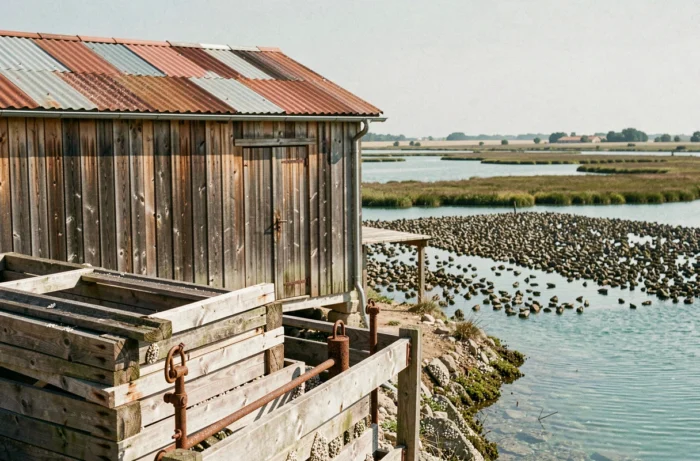
The oyster farm is one of the most recognizable settings of Demain nous appartient since the series launched on TF1 in 2017. This place, rooted in the daily lives of several central characters, embodies the link between fiction and the shellfish farming heritage of the Thau basin. But where is this set really located, and how much is studio work versus outdoor filming on the shores of the lagoon?
The Thau basin as the real backdrop for the oyster farm
The series Demain nous appartient is entirely filmed in Sète and its region, in Occitanie. The oyster farm fits into this logic: it evokes the real shellfish farms that line the Thau lagoon, between Sète, Bouzigues, Mèze, and Loupian.
The outdoor scenes of the farm utilize the natural landscape of the basin, with its oyster tables, docks, and the characteristic light of the lagoon. This setting is not a decorative artifice. The Thau lagoon concentrates a large part of French oyster production, and the farms that border it closely resemble the one seen on screen.
To understand in detail the oyster farm in the series Demain nous appartient, it is essential to distinguish between what is filmed in a natural setting and what is recreated in the studio.
Studio set or outdoor filming in Sète: what we know
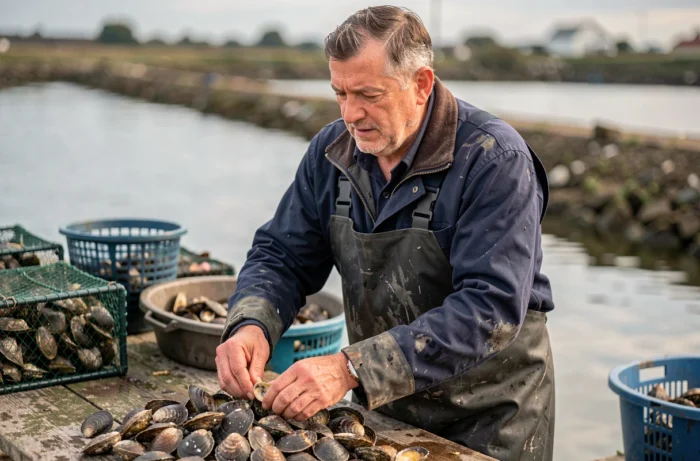
The production of Demain nous appartient has studios located in the Sète area, with a space dedicated to recreating many interior sets. The oyster farm is included: the interior scenes of the farm are filmed in the studio, in a set built for the needs of the fiction.
The exterior shots, on the other hand, are captured on the shores of the Thau lagoon. The series regularly uses real facades and environments from Sète and neighboring municipalities to visually anchor the action in the local landscape.
A set that has evolved over the seasons
The farm has undergone a visible redesign in certain seasons. Télé-Loisirs documented the presentation of a “new oyster farm” occupied by the characters Alex and Judith, with a completely restored set. These changes correspond to the narrative arcs: a change of ownership or a renovation in the story justifies a renewal of the set in the studio.
This approach is common in French daily series. The interior set of the farm does not have a real visitable address, unlike some outdoor locations such as the beach of Trois Digues or the Haut district of Sète, which fans can recognize and explore.
Narrative role of the farm in Demain nous appartient
The oyster farm is not just a backdrop. It serves as a place of dramatic tension, family transmission, and conflicts between characters. Several major plotlines have unfolded there since the first season.
- The farm has been the setting for conflicts related to the ownership and management of the oyster farming operation, involving characters Alex Bertrand and Chloé Delcourt.
- Violent events (assaults, disappearances) have taken place there to reinforce the series’ realistic grounding in the shellfish farming community.
- The location also serves as a meeting point and scenes of daily life, making it a stable reference for the viewer.
An article from Serieously published in August 2026 announces that a collapse of the oyster farm is among the dramatic events planned for the series’ return. This type of narrative catastrophe (comparable to the explosion at the school or the plane crash in previous seasons) shows that the farm is now treated as a narrative device in its own right, not just as a background set.
Visiting the filming locations of Demain nous appartient in Sète
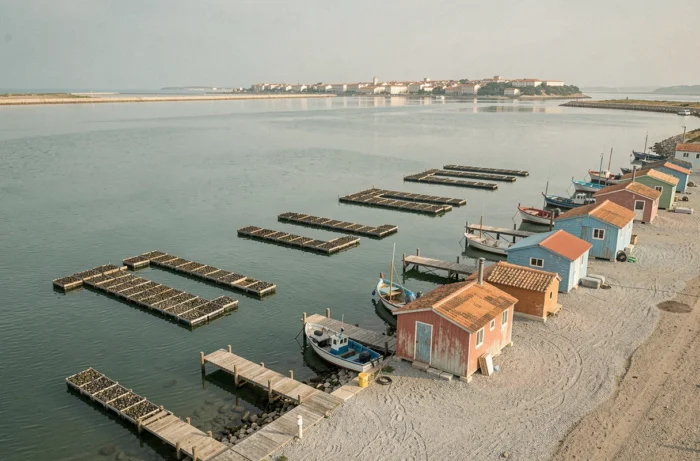
While the interior set of the farm remains inaccessible to the public (it is located in the production studios), several outdoor filming locations of the series are freely visitable. Fans visiting Sète can recognize a number of sites.
- The beach of Trois Digues, between Sète and Marseillan-Plage, serves as the setting for the Spoon beach hut in the fiction.
- The Haut district of Sète regularly appears in the exterior shots of the series.
- The shores of the Thau lagoon, particularly near Bouzigues and Mèze, offer a landscape very similar to that of the oyster farm as filmed.
Sète and the Thau basin have become tourism destinations linked to the series, with visitors coming to identify the real locations behind the fiction. The active oyster farms on the Thau lagoon also host tastings and tours, extending the experience for fans of the series as well as those curious about shellfish farming heritage.
A fictional set rooted in a very real territory
The oyster farm of Demain nous appartient does not exist as such at a specific address. Its interior is a studio set located in the production area in Sète, while its exterior shots rely on the authentic landscape of the Thau basin. This combination of studio and outdoor filming gives the location its visual credibility.
With the announced collapse for the 2026 season, the farm could radically change shape in the upcoming seasons. What will not change is the geographical anchoring of the series in the Sète territory and the place of oyster farming in its narrative identity.