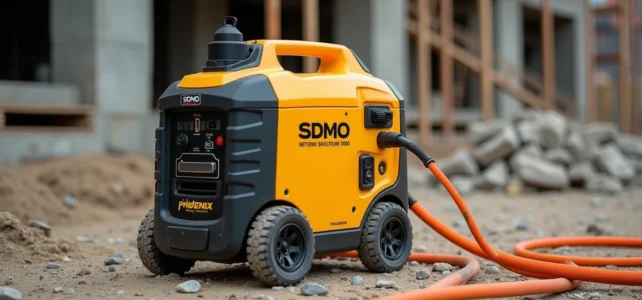
The SDMO Phoenix 3000 has a rated power of 3 kW in single-phase, placing it in the segment of gasoline generators intended for light and medium construction sites. But beyond the catalog specifications, it is the sound emission data, partial load consumption, and engine behavior that determine whether this unit truly delivers on its promises in the field.
Sound level of the SDMO Phoenix 3000: what product sheets do not detail
On a construction site, the issue of noise goes beyond mere inconvenience. In urban areas or near residences, the acoustic pressure of a generator conditions the hours of use and sometimes even the feasibility of the job.
The technical sheets for SDMO generators in this segment indicate a guaranteed acoustic power level of 96 LwA. This standardized value corresponds to the total sound energy emitted by the machine, but it does not directly inform what an operator perceives a few meters away.
The data that matters in the field is the acoustic pressure measured at a real distance. For the Phoenix 3000, the readings available on rental sheets indicate 73 dB(A) at 7 meters. In comparison, the Perform 3000 C5, a model close to the same Kohler-SDMO range, drops to 67 dB(A) at the same distance. This difference of 6 dB(A) represents a perceptible difference: it roughly corresponds to a doubling of the sensation of sound volume.
A detailed analysis of the performance of the SDMO Phoenix 3000 generator confirms that the choice of engine and casing explains most of this gap between the two models.
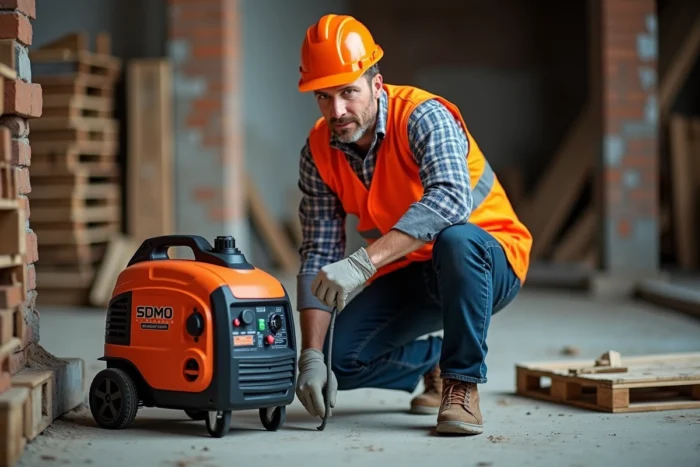
Sound comparison and consumption: Phoenix 3000 vs. Perform 3000 C5
Comparing two generators of the same rated power within the SDMO range allows for a concrete measurement of what each variant brings to the site. The table below gathers data from the available technical sheets.
| Criterion | Phoenix 3000 | Perform 3000 C5 |
|---|---|---|
| Rated power | 3 kW | 3 kW |
| Acoustic power (LwA) | 96 dB(A) | 96 dB(A) |
| Acoustic pressure at 7 m | 73 dB(A) | 67 dB(A) |
| Runtime at 75% load | Not documented | About 3.2 h |
The guaranteed acoustic power is the same, but the acoustic pressure at 7 m varies by 6 dB(A). This difference mainly arises from the design of the chassis and the management of airflow around the engine.
In terms of consumption, the available data for the Perform 3000 C5 at 75% load indicates a runtime of about 3.2 hours. For the Phoenix 3000, this value is not systematically documented in public sheets, making fuel planning less predictable without prior testing.
Gasoline engine and usage constraints on site
The Phoenix 3000 is equipped with a four-stroke gasoline engine. This type of engine has characteristics that directly influence the conditions of use.
- The gasoline fuel requires storage that complies with fire safety regulations on the site, with approved containers and a distance from heat sources.
- The engine oil level must be checked before each startup. A low-level sensor typically shuts off the engine to protect the block, but this safety feature does not eliminate the need for regular visual checks.
- The air filter requires frequent cleaning in dusty environments (demolition site, earthworks). A clogged filter degrades performance and increases fuel consumption.
- Manual recoil starting remains standard in this power segment. Cold starting in low temperatures may require several attempts if the spark plug or fuel circuit is not in good condition.
Regular maintenance of the filter and oil directly affects the reliability of the unit over the duration of a project. Neglecting these simple operations shortens the engine’s lifespan and increases the risk of failure during pouring or cutting.
What electrical devices can be powered with 3 kW
A power of 3 kW allows for the simultaneous operation of construction devices whose total consumption remains below this threshold. In practice, this covers an angle grinder, area lighting, and a cordless tool charger simultaneously.
Devices with high starting current (concrete mixer, compressor) pose a different problem. The starting current can exceed the peak capacity of the generator, triggering the protection and cutting off the power. Before connecting this type of equipment, one must compare the starting power of the device (often two to three times its rated power) with the maximum capacity of the generator.
Manufacturer’s warranty and SDMO wear parts
SDMO, a subsidiary of Kohler, applies a manufacturer’s warranty on its generators. The conditions vary according to the distribution network, but the standard coverage generally excludes wear parts: spark plug, air filter, oil filter, belt.
The availability of these parts is often an underestimated criterion when purchasing. SDMO products benefit from a professional distribution network (Tecnomat, specialized construction distributors), which facilitates the supply of consumables. A generator whose wear parts are unavailable becomes unusable long before reaching its mechanical end of life.
For intensive use on site, planning a maintenance kit (spark plug, air filter, suitable engine oil) upon acquisition avoids unplanned downtime. The cost of this kit remains marginal compared to the price of the generator itself.
The Phoenix 3000 positions itself as a versatile construction generator in the 3 kW segment, with a notable sound difference compared to the Perform 3000 C5 that deserves consideration based on the work environment. Durability depends less on the technical sheet than on adhering to engine maintenance intervals.