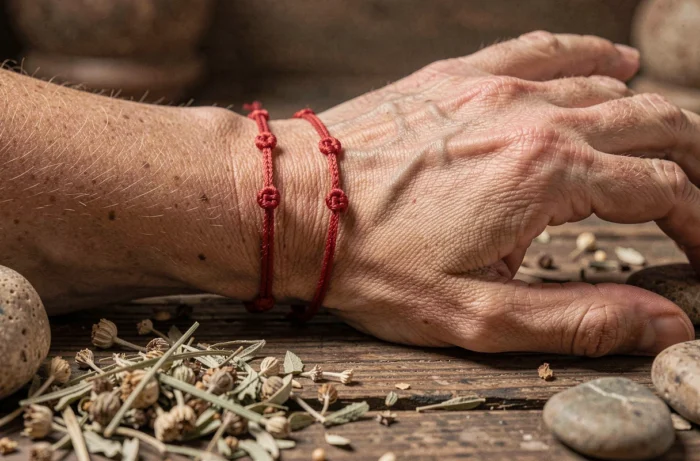
The red bracelet with seven knots concentrates distinct practices that are often amalgamated under the single label of “Kabbalah bracelet.” In reality, the knotted red thread traverses at least four independent ritual systems, each with its own rules of tying, laterality, and meaning. Understanding these differences conditions the validity of the chosen ritual.
Red thread and darchei ha-Emori: a disputed halakhic status
In Jewish tradition, the protective red thread does not have a consensus. A legal reading reported on Sefaria classifies this practice among the darchei ha-Emori, the “ways of the Amorites,” meaning superstitious customs borrowed from neighboring peoples rather than prescribed by the Torah.
This classification is not anecdotal. It means that some rabbinic decision-makers consider wearing the red thread to be forbidden, on par with other practices of divination or sympathetic magic. The red bracelet tied around the wrist, far from being a neutral gesture, lies in a halakhic gray area.
Other authorities accept it as a popular custom (minhag), without attributing any intrinsic protective power to it. In this reading, the thread serves as a reminder of intention, not as a talisman.
This distinction radically changes the way the bracelet is activated: a reminder of intention does not require purification or a charging ritual, whereas a talisman object assumes a precise protocol. For everything about the 7 knots red bracelet, this question of ritual status remains a prerequisite for any serious practice.
Seven knots, right or left wrist: the ritual varies by tradition
The number seven and the choice of wrist are not interchangeable from one system to another. Presenting the left wrist as a universal rule is an abusive simplification.
Laterality in Kabbalistic practice
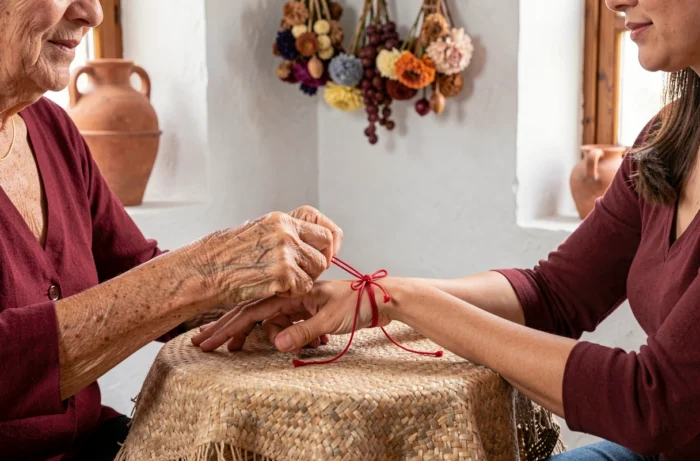
In Jewish mystical tradition, the left wrist corresponds to the receptive side of the body. The red thread is placed there to filter incoming negative energies. The tying is ideally done by a close person, not by the wearer themselves, which places the gesture in an interpersonal relationship rather than a solitary act.
The Hindu Santan Saptami and the right wrist
The Hindu ritual of Santan Saptami uses a thread with seven knots presented before Shiva and Parvati, then tied to the right wrist by mothers. The purpose is not protection against the evil eye but the health and longevity of children. The right wrist, in this context, corresponds to the side of action and outward projection.
Tibetan Buddhist practice
In Tibetan tradition, the red cord tied by a monk or lama receives a vocal blessing (mantra). The number of knots can vary. The Buddhist red thread does not necessarily require seven knots, contrary to what most commercial sites suggest.
Choosing a coherent ritual system remains preferable to mixing Kabbalistic left wrist, Hindu seven knots, and Buddhist mantra. Hybridization produces a decorative object, not a ritual object.
Meaning of each knot: targeted intention versus generic vow
The difference between an operating red thread bracelet and a fashion accessory lies in the quality of the intention set in each knot. “Protection” or “happiness” are not actionable intentions. They are too vague to anchor anything in the fiber.
A rigorous activation protocol assigns a distinct and concrete intention to each knot:
- The first knot can set a threshold intention, for example, the ability to identify a toxic situation before entering it
- The second knot anchors a specific relational intention, such as maintaining a clear boundary with a specific person
- The following knots cover other areas: physical health, clarity of decision, emotional stability, protection of the home, alignment with a professional goal
Each knot sets an intention in the fiber, the red thread acts as a conductor. The tying gesture is accompanied by a controlled exhalation at the moment of tightening. This coordination of breath and gesture is not symbolic: it creates a sensory anchoring that links intention to bodily memory.
Purification of the red bracelet: fumigation or saltwater
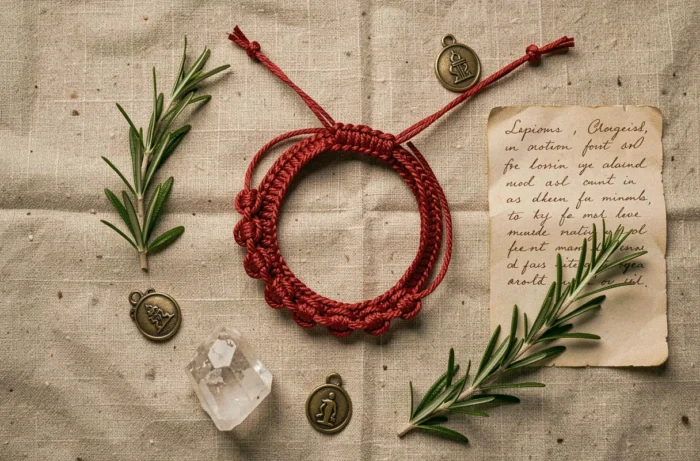
Before any activation, purification neutralizes the residual energies of the material. On a textile bracelet, fumigation with white sage remains the only recommendable method. Saltwater weakens the fibers, alters the integrity of the knots, and can discolor the red thread, compromising both strength and symbolism.
The fumigation protocol consists of passing the bracelet through the smoke for a few minutes, ensuring that the smoke envelops each section of the thread. Some practitioners use palo santo as an alternative to sage.
For bracelets combining red thread and stones (lithotherapy), the charging of the stones follows its own cycle. The hybridization of thread and stone complicates maintenance without providing measurable benefit on a ritual level. A pure red thread, properly activated, fulfills its function without mineral addition.
When to replace a worn red thread bracelet
A bracelet that breaks is not a bad sign in most traditions. The breaking of the thread signals that the protection cycle has come to an end. The bracelet has absorbed what it needed to absorb.
Concrete signs that call for a replacement:
- Marked discoloration of the thread, changing from bright red to pale pink or brown
- Knots that loosen spontaneously despite correct initial tying
- Thread showing areas of fraying or visible thinning
- Persistent subjective feeling that the bracelet “no longer works”
Replacement involves redoing the entire protocol: purification of the new thread, reformulation of intentions, accompanied tying. Reusing the intentions of an old bracelet without reformulating them amounts to wearing a neutral thread.
The seven knots red bracelet derives its value from the rigor of the protocol, not from the material. A properly activated cotton cord in a coherent tradition produces more than a silk bracelet mixed among three incompatible ritual systems.