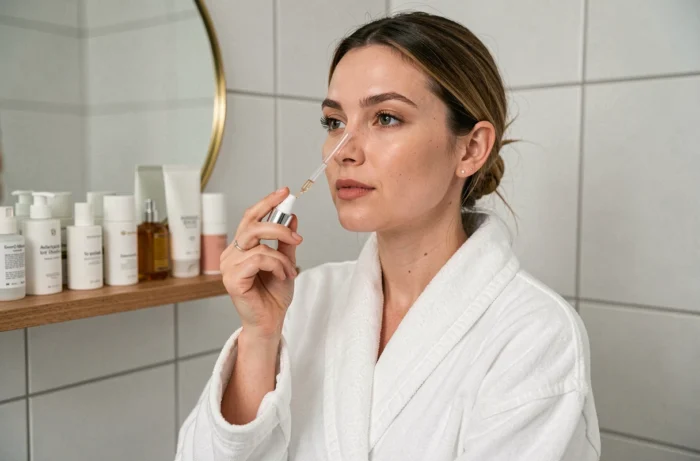
The reformulation of beauty routines no longer involves stacking products. It relies on a fine reading of the permitted active ingredients, an understanding of the skin barrier, and a rigorous sorting of viral trends. We have observed a shift towards short protocols, tailored to skin type and compliant with European regulatory developments over several seasons.
European regulation on retinol: what changes in your anti-aging products
The regulation (EU) 2024/996 caps vitamin A in cosmetics. Body lotions are now limited to 0.05% retinol equivalent, and whitening agents like alpha-arbutin or kojic acid are governed by strict maximum concentrations.
New products launched on the market must comply starting from November 1, 2025, with a total compliance obligation on shelves by May 1, 2027. For consumers, this means that high-dose retinol anti-aging serums will gradually disappear from European shelves.
We recommend checking the INCI list of your products containing retinol or vitamin A derivatives right now. Compliant formulations favor alternatives like bakuchiol or biomimetic peptides, which offer a smoothing effect without exceeding regulatory thresholds. Exploring the beauty universe of Mes Secrets de Beauté allows you to spot products already aligned with these new requirements.
The “Omnibus VI” has also shortened the withdrawal deadlines for ingredients classified as carcinogenic, mutagenic, or toxic for reproduction: brands now have only six months to withdraw a product from the market, down from twelve previously. Cosmetics accounted for more than a third of the alerts for dangerous products recorded by the European Safety Gate system in 2025, mainly for substances already banned like Lilial.
Minimalist face routine: skinimalism as a method
Skinimalism is not a trend driven by social media. It is a technical response to a real dermatological problem: cosmetic overload weakens the skin barrier. Layering serum, essence, ampoule, cream, and oil every morning causes interactions between actives that can trigger irritations, paradoxical dehydration, or sensitization.
An effective facial protocol consists of three steps morning and evening:
- A gentle cleanser suitable for skin pH (between 4.5 and 5.5), which removes residues without stripping the hydrolipidic film
- A unique active treatment targeting the main concern (pigmentation, fine lines, dehydration), applied on slightly damp skin to enhance penetration
- A sunscreen in the morning (SPF suitable for actual exposure), or an occlusive cream in the evening to seal in hydration
Three well-chosen products outperform eight poorly combined ones. The time-saving is real, but the true benefit is on the skin: less risk of cross-reaction between incompatible actives like vitamin C and certain exfoliating acids used simultaneously.
Makeup and autumn trends: hybrid texture and integrated care
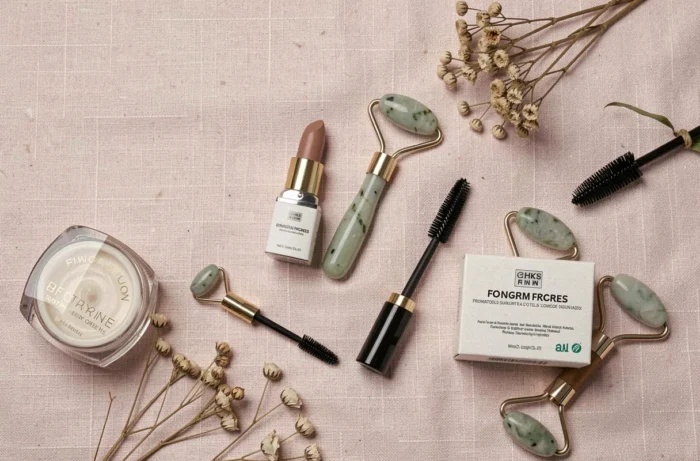
Current makeup trends converge towards hybrid textures that merge care and color. Foundations now incorporate hyaluronic acid or UV filters, lipsticks contain ceramides, and mascaras claim fortifying formulas for lashes.
This hybridization raises a technical question that mainstream articles overlook: is the concentration of actives in a makeup product sufficient to produce a measurable effect? In most cases, dosages remain below the threshold of clinical efficacy. A foundation containing 0.1% hyaluronic acid does not replace a serum dosed at 1 or 2%.
We observe that the most relevant formulas focus on protection rather than treatment. Makeup with SPF, non-comedogenic mineral pigments, and a proper hydrating base protect the skin during the day. Active treatment remains reserved for the care applied underneath or in the evening.
Lips and hydration: beyond gloss
Lip products illustrate this gap between promise and reality well. Lip balms containing irritating significant oils or synthetic fragrances worsen the dryness they claim to combat. An effective balm relies on occlusive fats (beeswax, shea butter) and a minimum of additives.
Hair and scalp: hair care as an extension of skin routine
The scalp is a distinct area of skin, with its sebaceous glands, microbiome, and unique sensitivity. Current trends finally incorporate this reality: scalp exfoliants, pre-shampoo serums, and targeted masks have become staples in hair routines.
The technical point to remember concerns pH. A shampoo with a pH that is too high (above 6) opens the hair cuticles and irritates the scalp. Professional formulations aim for a pH between 4.5 and 5.5, the same as that recommended for facial cleansers.
- Space out washes to two or three times a week to preserve protective sebum, except in cases of seborrheic dermatitis requiring specific treatment
- Apply moisturizing treatments (masks, conditioners) only on lengths, never on roots, to avoid greasiness
- Limit the heat from styling tools: a hairdryer at a reasonable distance damages less than a straightener in direct contact
Water and hydration: the underestimated impact on skin and hair
The quality of tap water directly influences skin and hair. Very hard water leaves a mineral deposit that dries out the hair fiber and can exacerbate eczema or dry skin. Installing a shower filter or using a final rinse with filtered water is a simple gesture with measurable effects on hair shine and skin comfort.
The most sophisticated beauty products do not compensate for aggressive water applied daily. Correcting the water source is sometimes more effective than adding an extra treatment. This reflex remains uncommon, even though it concerns a large portion of households in hard water areas.
The most effective beauty routine in 2025 is not the longest or the most expensive. It relies on actives compliant with the new European standards, a reduced number of well-dosed products, and attention to environmental factors such as water quality. The sorting of ingredients takes precedence over the accumulation of steps.