
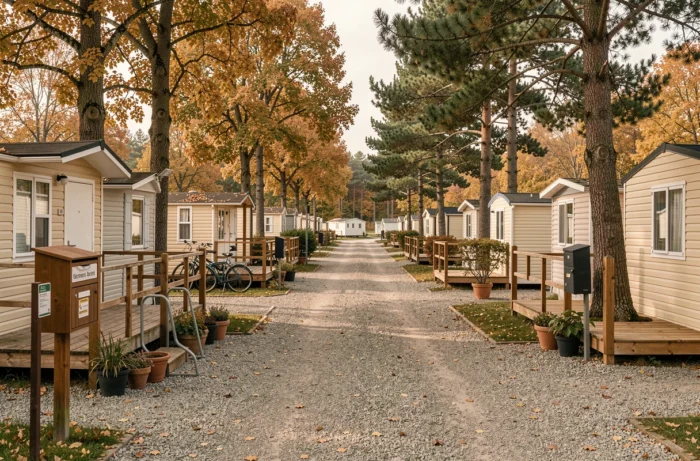
In French law, a person’s domicile is located where they have their principal establishment, according to Article 102 of the Civil Code. This definition does not mention any conditions related to the type of construction. A campsite open year-round can therefore constitute a domicile in the civil sense, even when the occupant resides in a mobile home, a chalet, or a caravan.
Civil domicile and administrative domiciliation: two distinct concepts
The confusion between these two terms fuels most misconceptions about permanent living in campsites. The civil domicile refers to the place where a person actually lives in a stable manner. No particular formalities are required to establish it: it is enough to actually reside there.
The administrative domiciliation, on the other hand, falls under a different mechanism. Provided for in Article L.264-1 of the Social Action and Families Code, it allows people without a stable domicile to obtain an address from a CCAS or an approved association. This address is used to receive mail, carry out civil status procedures, and declare taxes.
Crucial point: administrative domiciliation can be granted even if the installation in the campsite is irregular concerning urban planning. It is an autonomous right, disconnected from the legality of the place of residence. Some people choose to live in campsites open year-round to live while simultaneously obtaining a CCAS domiciliation, due to the inability to justify a conventional address with the authorities.
In practice, a permanent resident of a campsite can therefore accumulate a civil domicile (the campsite itself) and a separate administrative domiciliation if necessary. The two systems coexist without excluding each other.
Urban planning and land status: the real legal constraints
The question is not so much whether one can live in a campsite, but whether the campsite has the right to host permanent residents. Everything hinges on the local urban planning plan (PLU) of the municipality and the classification of the land.
Year-round opening and municipal authorization
A classified campsite can operate year-round only if its opening order provides for it and if the town hall authorizes it. Many campsites close for several months a year, making any permanent residence impossible from a regulatory standpoint.
For a campsite to offer residential pitches, it must comply with the provisions of the Urban Planning Code applicable to campsites and residential leisure parks. The manager and the municipality must agree on this residential purpose.
Mobile home, caravan, chalet: different rules
The type of lightweight habitat determines the administrative obligations:
- The caravan retains its status as a vehicle as long as it has its wheels and means of mobility. Its parking is free for up to three months a year on the same land. Beyond that, prior declaration is required (Article R.421-23 of the Urban Planning Code).
- The mobile home installed in a classified campsite is considered a mobile leisure residence. Once connected to utilities and placed on supports, some municipalities require additional permits if the occupancy becomes permanent.
- The chalet or removable lightweight construction follows a variable regime depending on its floor area: below a certain threshold, a prior declaration is sufficient; beyond that, a building permit may be required.
In all cases, installing a habitat on non-buildable land or in agricultural zones for year-round residence remains prohibited, except for exceptions provided by a STECAL (limited size and capacity sector) included in the PLU.
Winter truce and protection of permanent residents in campsites
A rarely addressed aspect concerns protection against eviction. As soon as a mobile home, caravan, or yurt constitutes the actual domicile of a person, the winter truce applies.
Article L.412-6 of the Code of Civil Execution Procedures stipulates that no eviction can be enforced by the public force between November 1 and March 31. This protection covers occupants of lightweight habitats used as their primary residence, whether installed on private land or in a campsite.
In practice, a campsite manager wishing to terminate a permanent resident’s contract cannot proceed with a forced eviction during this period. They must obtain a court decision and wait for the end of the truce for public force intervention.
Pitch contract and lease: the contractual framework to verify
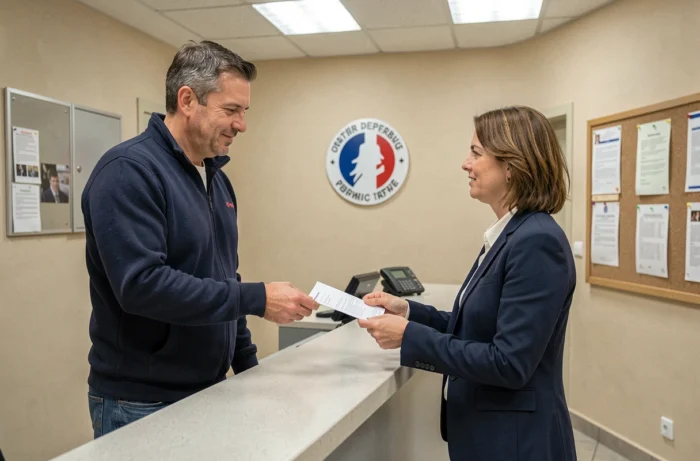
The legal link between the resident and the manager is based on a pitch rental contract, not a classic residential lease. This distinction has direct consequences on the stability of the occupancy.
The pitch rental contract does not benefit from the protections of the 1989 residential lease law. The manager can modify the conditions at each renewal: rent increase, change of internal regulations, refusal to renew. The resident has no right to remain in the premises beyond the term of the contract.
Some campsites with a residential purpose offer renewable annual contracts, with more protective clauses. Before committing, several elements should be checked:
- The duration of the contract and the renewal conditions (tacit renewal or express renewal).
- The charges included or billed separately (water, electricity, tourist tax, maintenance of common areas).
- The clauses for early termination and the notice periods imposed on the manager.
- The existence of internal regulations limiting certain activities or imposing schedules.
Case law tends to reclassify certain pitch contracts as commercial leases when the campsite has an outdoor hospitality activity, which modifies the rules of valuation and renewal. A permanent resident has an interest in keeping all evidence of their continuous occupancy to assert their rights in case of dispute.
Establishing domicile in a campsite open year-round is therefore legally possible, but the solidity of this installation depends as much on urban planning law as on the contract signed with the manager. The protection offered by the winter truce serves as a safety net, without guaranteeing long-term maintenance on the pitch.